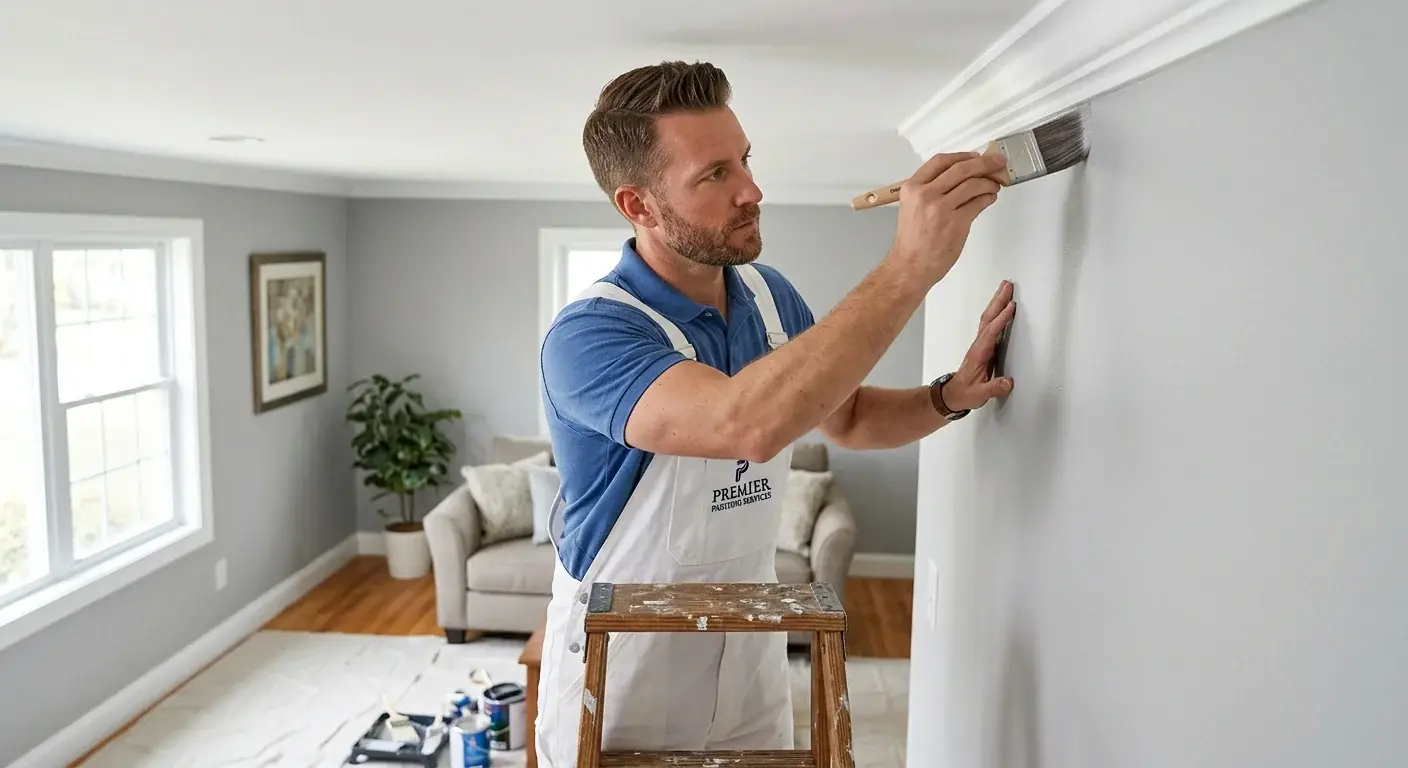
Yes, you can paint a house interior yourself, and most people can do it well if they’re patient with prep. For a typical San Diego bedroom (about 12 by 12, eight-foot ceilings), expect to spend $200 to $600 on materials and plan two full weekends. One weekend for prep and primer, one for two coats of finish and dry time. The biggest variables in San Diego are humidity and the marine layer, both of which slow drying. Rushing the second coat is the most common DIY failure here.
This guide is the realistic version. Not the marketing version. We’re a working San Diego painting company, and we wrote this for the homeowner who wants to know what they’re actually getting into before they buy a $40 gallon at the hardware store.
Tools and materials you actually need
Skip the all-in-one starter kits. Most of them include throwaway brushes that shed bristles into your finish. Buy the few things that matter and don’t overspend on the rest.
For brushes, get a Purdy XL Glide 2.5-inch angled sash brush. It’s around $18, holds an edge, and lasts years if you clean it. For rolling walls, a Wooster 9-inch frame with a Wooster Pro/Doo-Z 3/8-inch nap cover handles smooth-to-light-texture drywall, which covers most San Diego homes built after 1985. For older stucco-textured interior walls (common in pre-1970 Mission Hills, North Park, and South Park), bump up to a 1/2-inch nap.
Other essentials: 3M ScotchBlue painter’s tape (the 2090 or 2093 line releases cleanly after a few days, the cheaper green tape does not), a five-gallon bucket with a Wooster Hefty Deep-Well roller grid (skip the tray, the bucket holds enough paint for a full wall and doesn’t spill), a 4-foot extension pole, a sturdy 5-in-1 painter’s tool, a 220-grit sanding sponge, lightweight spackle, an LED work light, and either canvas or Plastidip rubberized drop cloths. Plastic sheeting tears, slides, and feels cheap because it is. Canvas drop cloths from a Sherwin-Williams or Dunn-Edwards store run about $25 each and last decades.
Total tool spend the first time out: roughly $120. After that, your only recurring cost is paint, rollers, and tape.
Prep work that 70% of DIYers skip
This is the section that separates a paint job that looks great for ten years from one that peels in eighteen months. Pros spend 40 to 50 percent of total project time on prep. Most DIYers spend less than 10 percent. That gap is why the results don’t match.
Start by washing the walls. San Diego homes pick up a thin film of marine-air salt residue, kitchen grease, and (in living rooms with candles or fireplaces) soot. Paint will not bond reliably to any of it. Use a TSP-free degreaser like Krud Kutter Original or Simple Green, wipe walls with a damp microfiber cloth, then rinse with clean water. Let surfaces fully dry, which in coastal humidity can take four to six hours.
Next, fill all nail holes and dents with lightweight spackle. Apply with the 5-in-1 tool, let it dry the full time on the tub (usually 30 to 60 minutes, longer in coastal humidity), then sand flush with the 220-grit sponge. Don’t skip sanding. Unsanded spackle telegraphs through finish paint as little raised circles that you’ll see every morning under angled sunlight.
Glossy spots from old semi-gloss trim repaints, kitchen splash zones, or bathroom areas need a light scuff sand. Paint does not stick to gloss. Sand until the sheen is dull, then wipe with a damp cloth.
Finally, prime any stains, water spots, repaired areas, or color changes going from dark to light. Use a stain-blocking primer like Zinsser BIN (shellac-based, blocks anything but smells strong, ventilate well) or Zinsser Bulls Eye 1-2-3 (water-based, lighter performance, no smell). Skipping primer is the single most common reason DIY paint looks “off” against pro work. The pros are not magicians, they just primed the wall.
The right paint for San Diego interiors
San Diego’s air quality regulations push toward low-VOC paint, and California’s South Coast AQMD limits interior paint to 50 grams per liter of VOCs (most premium interior lines meet this without trying). All three major lines we spec, Sherwin-Williams Emerald, Behr Premium Plus Ultra, and Dunn-Edwards Spartashield, qualify. Pick the one closest to you. Driving across town for paint is wasted time.
For sheen, the rule we follow in San Diego coastal and inland zones is different. In coastal zones (anything within five miles of the water, including La Jolla, Pacific Beach, Point Loma, Coronado, Encinitas, and Carlsbad), use satin in kitchens and bathrooms, eggshell in living areas, and flat only in bedrooms or ceilings. Marine-layer moisture means flat finishes in coastal kitchens grow visible mildew in two to three years. Satin wipes clean and resists it.
In inland zones (Poway, Escondido, Santee, El Cajon, Ramona), humidity is lower and flat finishes hold up longer. You can use flat in most rooms except the kitchen and bath. Eggshell is the safe middle.
Don’t use ceiling paint on walls or wall paint on ceilings. Ceiling paint is intentionally flat and high-hide, and it splatters less when you’re rolling overhead. It’s a different product for a reason.
For coverage, one gallon covers about 350 square feet of smooth drywall with a single coat. A 12x12 bedroom with eight-foot ceilings has roughly 380 square feet of wall surface (subtracting one door and one window), so you need two gallons for two coats with a small leftover for touch-ups. Buying one gallon and hoping is the second most common DIY mistake.
Premium paint costs $55 to $85 per gallon in San Diego. Bargain paint at $25 per gallon needs three coats to look like one coat of premium, costs more in roller covers and your weekend, and never looks as good. Buy the better paint.
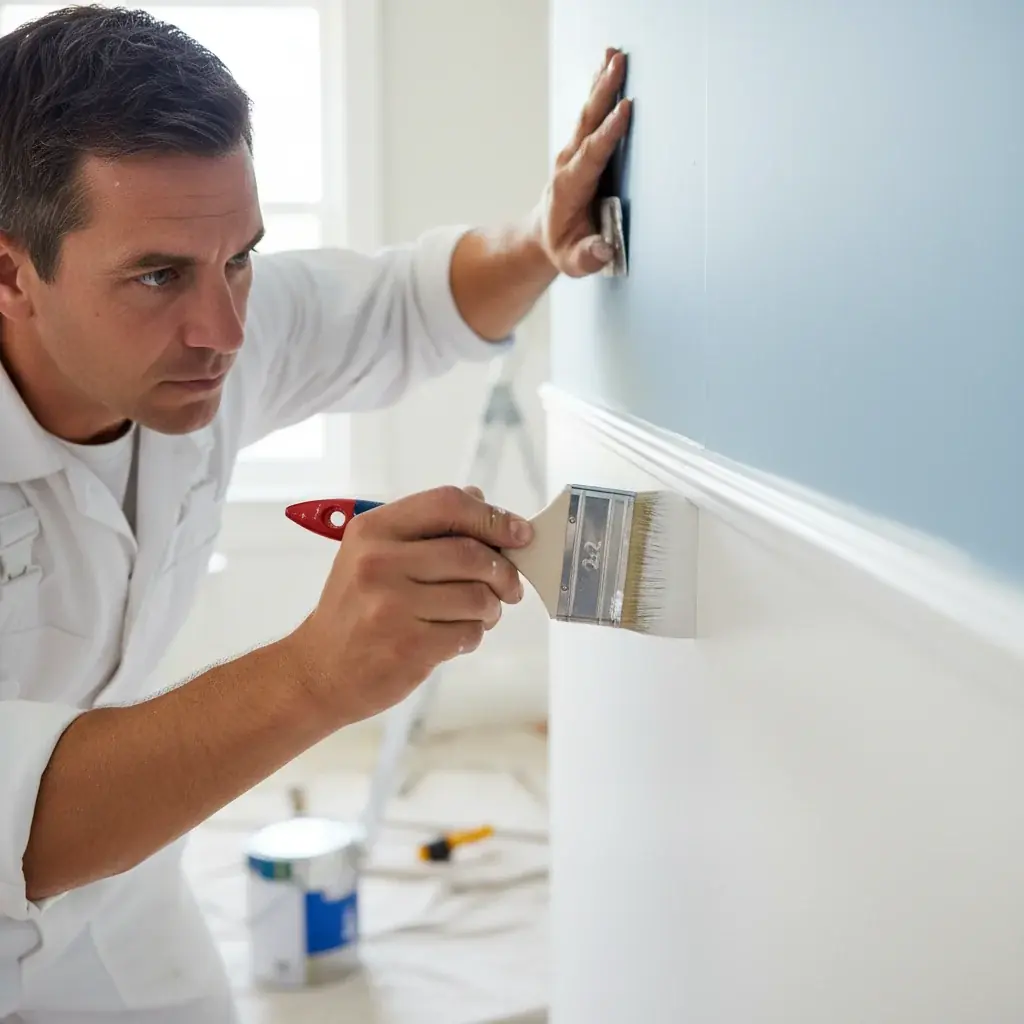
Step by step (with actual San Diego timing)
Here’s the realistic sequence for one room. Adjust upward for whole-house jobs.
1. Move and cover. Pull furniture to the room’s center, cover with plastic. Pull off outlet covers, switch plates, and any wall-mounted hardware. Tape off baseboards, window trim, and door casings with 3M ScotchBlue 2090. Press tape edges down hard with the 5-in-1 tool. Lay canvas drop cloths over flooring. Allow 45 minutes.
2. Cut in. Load the Purdy XL Glide, tap off excess on the bucket grid, and cut a clean 2 to 3-inch band along the ceiling line, baseboard, corners, and around windows and doors. Don’t cut in the whole room at once. Cut in roughly three feet of wall, then roll that section before the cut-in dries. This keeps a wet edge and prevents the “halo” effect where cut-in lines show through the rolled finish. Allow 45 to 75 minutes.
3. Roll the wall. Load the roller in the bucket, roll out excess on the grid, and apply paint in a loose W-pattern about three feet wide, then fill the W with vertical strokes. Move into the next section while the previous one’s still wet. Keep moderate pressure. Pushing harder doesn’t add coverage, it leaves track lines. Allow 60 to 90 minutes for a typical bedroom.
4. First-coat dry time. This is where San Diego matters. The label says recoat in two hours. In coastal marine-layer mornings (humidity above 70 percent), that’s optimistic. Wait a minimum of four hours, ideally overnight. The first coat needs to fully chemically cure, not just feel dry to touch. Recoating too soon causes the second coat to drag the first coat off the wall in patches.
5. Second coat. Repeat steps 2 and 3 exactly. Most premium paints fully hide with two coats. If you’re going dark-to-light or covering a strong color, plan three coats.
6. Pull tape, inspect. Pull tape at a 45-degree angle while the second coat is still slightly tacky (about 60 to 90 minutes after rolling). If the paint film dries fully onto the tape, you’ll tear the finish. Inspect under an angled LED light for missed spots, drips, or thin areas. Touch up with a brush.
7. Cure time. The paint is dry in four hours. It’s fully cured in 21 to 30 days. Wait at least seven days before washing the wall, hanging anything heavy, or scrubbing.
For a single bedroom, total realistic time is 12 to 16 hours of actual work spread across two days. For a whole 1,800-square-foot house, it’s 60 to 90 hours, which is most of two full weekends plus weekday evenings.
When DIY makes sense versus when to call a pro
The honest math, no marketing slant.
DIY makes sense when:
- The space is one or two rooms, not the whole house.
- Ceilings are eight or nine feet, no scaffolding required.
- Walls are in good shape (no major drywall damage, no popcorn ceiling, no water stains).
- The house was built after 1978, so lead paint is not a concern.
- You enjoy the work and have two free weekends.
- You can recover the $200 to $600 in materials by saving against a $700 to $1,800 pro quote per room.
Call a pro when:
- The job is a whole-house repaint. The labor cost in time and back pain is rarely worth it.
- Ceilings are higher than nine feet. Working on ladders for 30+ hours is genuinely dangerous, and inland summer heat makes it worse.
- The house has popcorn ceilings or heavy texture that needs careful handling, or the popcorn is pre-1980 and might contain asbestos.
- The home was built before 1978. Lead paint disturbance triggers federal EPA RRP Rule requirements, and pros are certified to handle it safely.
- You have water damage, drywall cracks wider than a hairline, or visible mildew. Those are repair problems disguised as paint problems.
- Time is the real constraint. A two-person pro crew finishes a 1,800-square-foot interior in three to four days. Solo DIY is three to four weekends.
For decision-making against actual San Diego prices, our interior painting cost guide breaks down the numbers room by room. If you want the full pro process to compare against, see the professional interior painting process.
Common San Diego-specific DIY mistakes
A few mistakes show up in San Diego homes that wouldn’t in Phoenix or Denver. They’re worth knowing about.
Painting in early morning marine-layer humidity. Coastal humidity in May, June, and July often sits at 80 to 90 percent before 10 a.m. Paint applied in that window dries slowly, attracts dust, and can develop a faint cloudy sheen called “blushing” in water-based paints. The fix is simple: don’t open the first can before 10 a.m. in coastal zones during marine layer months. Mid-morning to mid-afternoon is the productive window.
Painting on Santa Ana days when the surface is too hot. Inland Santa Ana events push interior wall surface temperatures past 85°F even with windows closed. Paint applied to a hot wall flashes (dries too fast on the surface) before it can level out, leaving roller stipple and lap marks visible for the life of the finish. If you can feel real warmth through the wall with your palm, wait for the weather to break.
Skipping primer on stucco-textured interior walls. Many pre-1970 San Diego homes have intentional stucco-style texture on interior walls. That texture is thirsty. Going straight to finish paint means the first coat soaks in unevenly and looks splotchy even after two coats. Always prime textured walls first.
Buying the cheapest tape because it’s all “blue.” The store-brand and cheap-import blue tapes have weaker release adhesives and tear the finish off baseboards and ceilings when you pull them. Use 3M ScotchBlue 2090 or 2093. The $4 difference per roll saves an hour of touch-up.
Closing up the house while painting. Even low-VOC paint releases some solvents during cure. San Diego’s mild climate means you can almost always crack windows and run a fan during and after painting. Don’t seal the house up the way you might in winter elsewhere. Ventilation helps the paint cure faster too.
Frequently asked questions
How long does paint take to dry in San Diego?
In dry inland conditions, premium latex paint is dry to touch in one hour and recoatable in two to four hours. In coastal marine-layer humidity, those times can double. Always wait four hours minimum between coats, more if you’re in Carlsbad, Encinitas, La Jolla, Pacific Beach, Point Loma, or Coronado during May, June, or July. Full cure takes 21 to 30 days regardless of zone.
Can you paint over wallpaper?
You can, but you usually shouldn’t. Paint added to wallpaper soaks into the paper, can cause edges to lift, and creates an uneven texture that’s almost impossible to fix later. If the wallpaper is very old, well-adhered, and fully sealed first with an oil-based primer like Zinsser Cover Stain, painting over it is possible. In most San Diego homes, removing the wallpaper first is the better answer. Our wallpaper removal cost guide has the realistic numbers.
Do you have to prime new drywall?
Yes, with a drywall-specific primer (sometimes called PVA primer). New drywall has two surfaces: paper face and joint compound. They absorb paint at very different rates, so going straight to finish paint creates a patchy “flashing” effect where joints show through. One coat of PVA primer evens it out and saves at least one coat of finish paint.
What’s the cheapest interior paint that actually lasts?
In our experience across thousands of San Diego jobs, the floor for “lasts more than five years and still looks good” is around $45 per gallon. Behr Premium Plus Ultra at Home Depot, Sherwin-Williams Cashmere on sale, and Dunn-Edwards Suprema all hit that band. Below $35 per gallon, you’re trading paint quality for marginal savings that disappear once you factor in the extra coat and the shorter life. For paint sheen tradeoffs at each price tier, see our sheen guide.
Can you paint in marine layer?
Indoor painting in marine layer is fine as long as the room itself is dry and ventilated. The concern is dry time, not application. Run a ceiling fan or floor fan to move air, and double the recoat time printed on the can. Avoid painting kitchens and bathrooms on dense marine-layer mornings because those rooms hold humidity longer than the rest of the house.
What’s the best color for a San Diego interior?
Coastal natural light is cooler and bluer than inland light, which means warm whites (creamy off-whites, ivory, soft greige) read more neutral in coastal homes, while crisp cool whites can feel sterile. Inland, the light is warmer, so cool whites and grays balance the warm light. For specific 2026 color recommendations, see our San Diego interior paint colors guide.
Final reality check
DIY interior painting is one of the few real-money home improvement wins still available to a careful homeowner. The materials cost is honest, the skills are learnable in a weekend, and the result can match pro work if you respect the prep. Where DIY breaks down is scale and ladders. One bedroom, fine. Two-story foyer with vaulted ceilings, please don’t.
If you’re a third of the way into a whole-house DIY and you’re realizing the timeline doesn’t work, that’s not failure. That’s information. Call us at (858) 925-5546 for a free estimate. We’ll finish what you started, match your colors, and give you a real timeline. No judgment. We’ve seen the half-painted hallway before, and we know exactly how to make it right. Learn more about our interior painting service or read related cost data before you decide.
Sources and further reading
- Sherwin-Williams Emerald Interior tech sheet
- Behr Premium Plus Ultra product page
- Dunn-Edwards Spartashield product info
- Purdy XL Glide brush specs
- Wooster Pro/Doo-Z roller covers
- 3M ScotchBlue painter’s tape product line
- EPA Lead Renovation, Repair and Painting Rule
- California South Coast AQMD Rule 1113 (architectural coatings)
- Zinsser BIN primer technical data
- Bob Vila on interior painting prep
- Family Handyman painting techniques
- This Old House: How to paint a room
- Benjamin Moore room painting guide
- Home Depot how-to: paint a room