You want to transform your dusty, stained concrete garage floor into a clean, durable, and impressive space. The two leading options you’ll find are epoxy and polyaspartic coatings. While they might look similar at first glance, their chemistry, performance, and installation process are quite different, especially for homeowners here in San Diego.
Choosing the right one means weighing factors like your budget, how quickly you need your garage back, and how much sunlight it gets. Let’s break down the real-world differences between polyaspartic vs epoxy to help you find the best garage floor coating for your home.
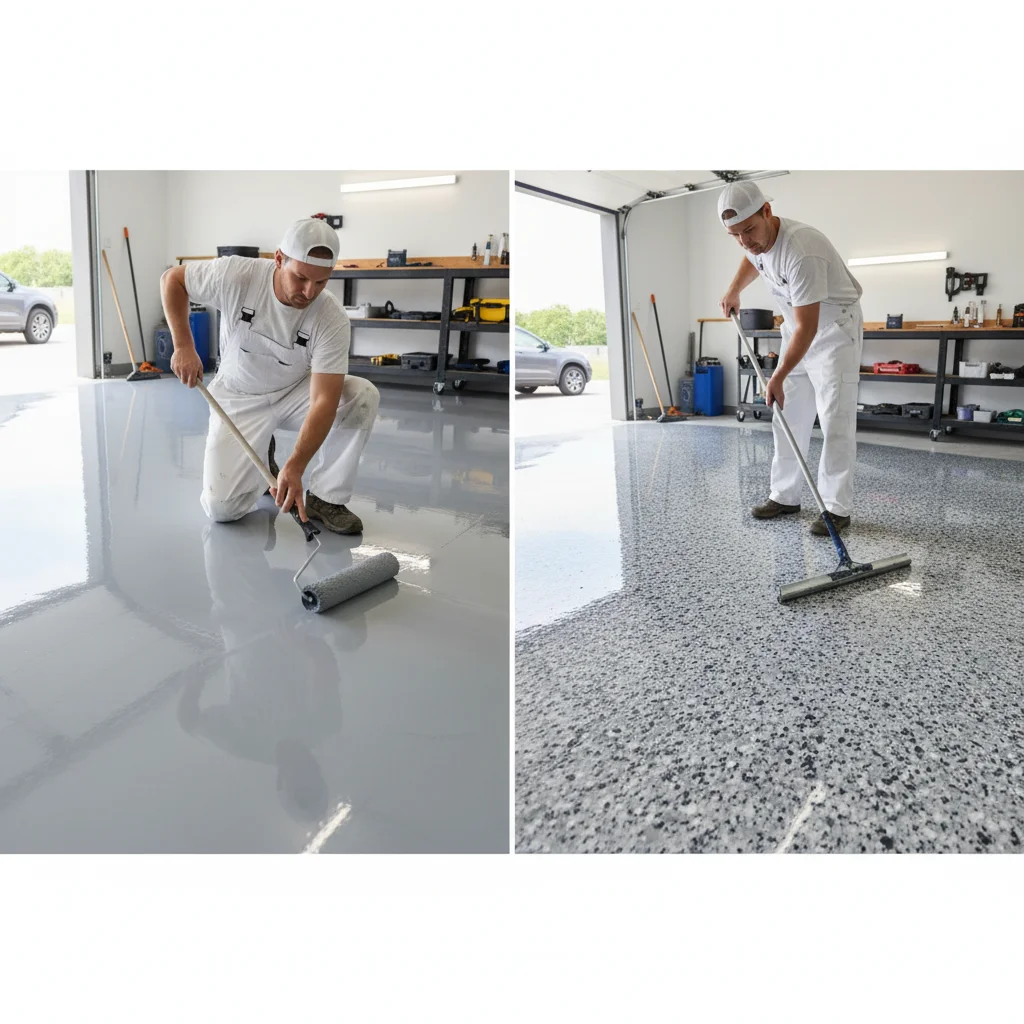
What’s the real difference between polyaspartic and epoxy?
At a chemical level, both are two-part systems that create a hard, resinous surface when mixed. But the specific chemistry dictates how they behave during and after installation.
Epoxy is the classic, tried-and-true garage floor coating. It’s a thermosetting resin that consists of a resin and a hardener. When mixed, they undergo a chemical reaction that creates a thick, hard, and highly durable surface. Think of it as the original workhorse of garage floors. It bonds incredibly well to properly prepared concrete and builds a thick, protective layer that resists moisture and many chemicals. However, it has a long cure time and can be sensitive to UV light.
Polyaspartic coatings are a newer technology. They are a type of polyurea, which is a more advanced polymer. While also a two-part system, the chemical reaction happens much faster. This technology was initially developed for industrial applications like bridges and railcars where a tough coating was needed with a very rapid return to service. Polyaspartic coatings are more flexible, more resistant to abrasion, and completely stable in UV light, meaning they won’t turn yellow.
The main takeaway is this: Epoxy is a high-solids, slow-curing system that builds thickness, while polyaspartic is a fast-curing, flexible system with superior UV and scratch resistance.
Cost comparison: what you pay per square foot for each
For most San Diego homeowners, the budget is a critical part of the decision. There is a clear price difference between the two systems, driven primarily by material costs and the labor involved.
Generally, a professionally installed epoxy garage floor in San Diego costs between $4 and $7 per square foot. This price includes the essential surface preparation (diamond grinding), materials, and labor for a multi-coat system. It’s the more budget-friendly option upfront and provides excellent value and protection for the money.
A full polyaspartic garage floor system typically costs between $6 and $10 per square foot. The higher price comes from two places. First, the raw materials for polyaspartic coatings are more expensive than epoxy resins. Second, the rapid cure time requires a highly skilled and efficient installation team. There’s very little room for error, which demands a higher level of expertise.
While epoxy wins on upfront cost, it’s important to consider the long-term value. If your garage gets a lot of sun and you want to avoid yellowing, or if you need the absolute best in scratch resistance, the extra investment in polyaspartic may pay off over the life of the floor. For a more detailed breakdown, you can read our guide on garage epoxy floor coating San Diego cost.
Cure time: the one-day floor vs the multi-day floor
How long can you afford to have your garage out of commission? This is where polyaspartic technology truly shines and presents its most significant advantage.
An epoxy floor installation is a multi-day process.
- Day 1: Diamond grind the concrete and apply the epoxy primer or base coat. This coat needs 12-24 hours to cure before it can be walked on.
- Day 2: Apply the color coat and broadcast decorative flakes. This layer also needs another 12-24 hours to cure.
- Day 3: Apply the final clear topcoat.
- Cure Time: After the final coat, you’ll need to wait another 24-48 hours before light foot traffic and up to 7 days before you can park your car on it. The total time from start to finish can easily be 4-5 days.
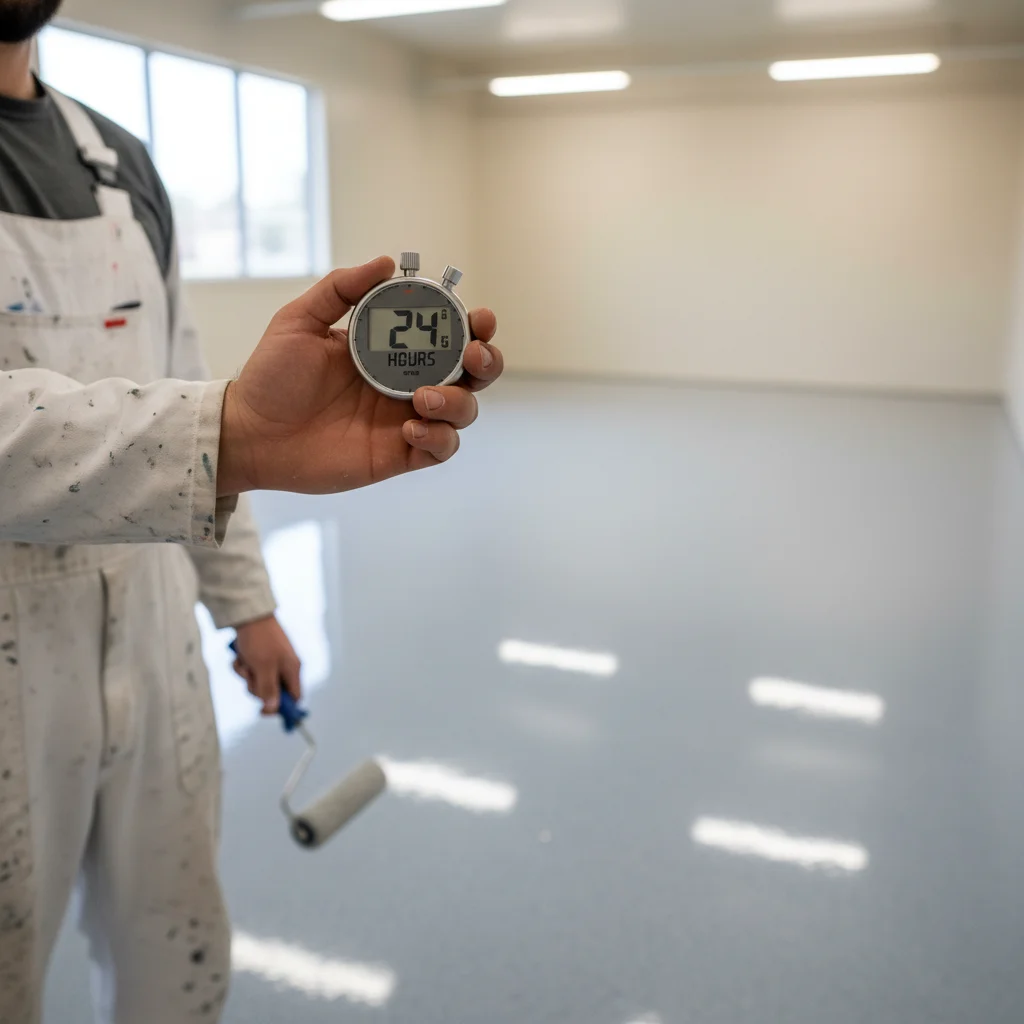
A full polyaspartic floor system can be installed in a single day.
- Morning: The crew arrives, diamond grinds the concrete, and applies the pigmented polyaspartic base coat.
- Mid-day: After a short cure time of only 1-2 hours, they broadcast the flakes and scrape off the excess.
- Afternoon: They apply the final clear polyaspartic topcoat.
- Cure Time: The floor is typically ready for foot traffic in just 4-6 hours and ready for your car in as little as 24 hours.
For busy families who can’t afford to lose access to their garage for nearly a week, the one-day polyaspartic installation is a game-changer.
UV resistance and why it matters in San Diego garages
Here in San Diego, we’re blessed with year-round sunshine. While we love it, that constant UV exposure can be tough on building materials, including garage floor coatings. This is a critical factor where polyaspartic has a major chemical advantage.
Standard aromatic epoxies, especially 100% solids epoxy, are prone to “ambering” or yellowing over time when exposed to sunlight. If you have windows in your garage or tend to leave the garage door open often, any part of the floor hit by direct sun will gradually change color. A light gray floor can take on a yellowish tint, and a white floor can look dingy. This doesn’t necessarily mean the coating is failing, but it’s an aesthetic issue that bothers many homeowners.
Polyaspartic coatings, on the other hand, are aliphatic. This is a technical term meaning their chemical structure is stable under UV radiation. They are non-yellowing. A polyaspartic floor will maintain its original color and clarity for its entire lifespan, even in the sunniest San Diego garages. This makes it the clear winner for any space with natural light exposure. It ensures that the color you picked is the color you’ll have years from now.
Durability and chemical resistance head-to-head
Both epoxy and polyaspartic systems offer a massive upgrade in durability over bare concrete. They both protect against stains from oil, gasoline, and other automotive fluids. However, they have different strengths.
Epoxy cures into an extremely hard, rigid surface. This gives it incredible compressive strength, meaning it can withstand a huge amount of weight without being crushed. It’s also highly resistant to chemical spills like battery acid. The downside of this hardness is that it can be somewhat brittle. A dropped heavy wrench or tool is more likely to chip or crack an epoxy floor. It can also be more susceptible to fine scratches over time.
Polyaspartic coatings are more flexible and elastic than epoxy. This flexibility makes them far more resistant to abrasion and scratching. The surface is less likely to show wear from shuffling feet, dragging storage bins, or rolling toolboxes. Its elasticity also makes it more resistant to impacts, so it’s less likely to chip.
When it comes to “hot-tire pickup”—where hot tires can soften a coating and cause it to peel—both systems perform well if installed correctly. The key isn’t the chemical, but the preparation. Proper diamond grinding creates a porous concrete profile for the coating to bite into. This mechanical bond is what prevents peeling. At Paint Pros San Diego, every epoxy floor coating project, regardless of material, starts with this essential prep work.
Which one is the better choice for your garage
So, after comparing the key features, which coating is right for you? It comes down to your priorities.
You should choose an Epoxy Floor Coating if:
- Budget is your top priority. Epoxy offers fantastic protection and aesthetics for a lower upfront investment.
- Your garage has no windows and you rarely leave the door open, minimizing UV exposure.
- You can manage without access to your garage for about 4-5 days during installation and curing.
- You need extreme compressive strength for very heavy, stationary equipment.
You should choose a Polyaspartic Floor Coating if:
- A fast return to service is essential. You want your garage back and ready for your car in 24-48 hours.
- Your garage gets direct sunlight. The UV stability will prevent yellowing and keep your floor looking new.
- Superior scratch and abrasion resistance is important. If you have kids, pets, or use your garage as a workshop, polyaspartic will hold up better to daily wear and tear.
- You want the most advanced technology and are willing to invest more for long-term performance and aesthetics.
A popular and effective compromise is a hybrid system. We often install an epoxy base coat for its thickness and excellent adhesion, followed by a polyaspartic topcoat to provide UV stability and superior scratch resistance. This gives you many of the benefits of a full polyaspartic system at a more moderate price point.
When to call us
Whether you choose epoxy, polyaspartic, or a hybrid system, the single most important factor for a long-lasting floor is professional surface preparation. DIY kits that use acid etching simply can’t match the mechanical bond created by diamond grinding. An improperly prepped floor will peel, guaranteed.
That’s why this is a job best left to experienced professionals. We have the right equipment and expertise to ensure your concrete is perfectly profiled for maximum adhesion. You can verify our license (and any contractor’s) on the CSLB website. If you’re ready to transform your garage, we’re here to help you choose the right system for your needs and budget.
Call us at (858) 925-5546 for a same-day estimate.