Freshly painted walls can transform a room, but if the trim and baseboards are scuffed, chipped, or yellowed, the effect is incomplete. That crisp, finishing touch that makes a space feel truly polished comes from well-painted trim. It frames your walls, defines the architecture of your home, and takes a surprising amount of daily abuse.
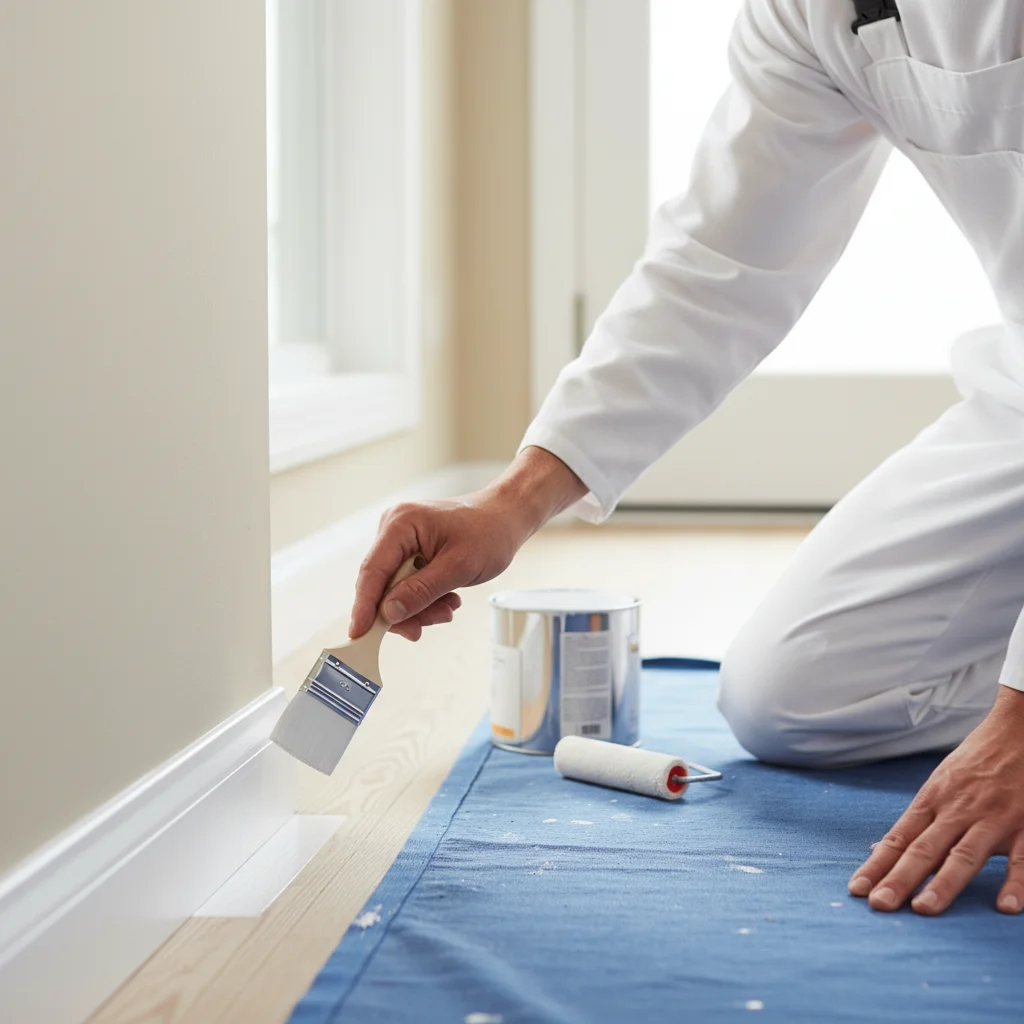
So, how much does it cost to get that professional look in San Diego, and what does the process actually involve? We’ll break down the costs, the methods, and the small details that make a big difference.
What trim painting actually includes
When painters talk about “trim,” it’s a catch-all term for the woodwork that finishes a room. A full trim, doors, and baseboards package typically covers several elements:
- Baseboards: The boards running along the bottom of the wall. They protect the wall from kicks, scuffs, and vacuum cleaners.
- Door Casings: The molding that frames your interior doors.
- Window Casings & Sills: The trim around your windows and the flat ledge at the bottom.
- Doors: Interior doors themselves, which often need painting to match the fresh casings.
- Crown Molding: The decorative trim that runs along the top of the wall, where it meets the ceiling. Not all San Diego homes have this, but it’s a common feature in styles from craftsman to colonial.
- Wainscoting or Chair Rail: Decorative paneling or molding part-way up the wall.
When you get a quote, it should specify exactly which of these elements are included. Painting baseboards alone is a different job than painting every door, casing, and window in a house. The more complex the woodwork, the more time and detail the job requires.
Cost ranges in 2026 by linear foot and by room
The trim painting cost in San Diego depends on the scope of work, the condition of the existing trim, and the method used. Here are the typical price ranges you can expect to see in 2026.
Cost by linear foot and by door
- Baseboard Painting Cost: For standard-height baseboards (3-5 inches), expect to pay between $1.50 and $3.50 per linear foot. The price is on the lower end if the baseboards are in good shape and just need a refresh coat. It trends toward the higher end if they require extensive sanding, filling, and caulking, or if you’re making a dramatic color change (like from dark wood to white).
- Door Painting Cost: A standard interior door typically costs $75 to $150 per door (one side) to paint. French doors or doors with many detailed panels will be more. This price usually includes painting both the door and its casing. Factors that influence the cost include whether the hardware needs to be removed and reinstalled, and if the doors need to be taken off their hinges for spraying.
Cost by the room
Most homeowners paint trim as part of a larger project. For a standard 12x12 foot bedroom, you might have about 48 linear feet of baseboards, one door, and one window.
- Baseboards: 48 ft x $2.50/ft = $120
- Door & Casing: 1 door x $115/door = $115
- Window & Casing: 1 window x $60/window = $60
- Total Estimated Trim Cost: ~$295 per room
This is just an example. The total cost will scale with the number of doors, windows, and the amount of prep work needed. It’s often more cost-effective to paint the trim for several rooms or the entire house at once. For a complete picture of room costs, see our guide on interior painting cost in San Diego.
Sheen choice: semi-gloss vs satin on trim
The paint finish you choose for your trim impacts both its look and durability. The two most popular choices are semi-gloss and satin.
Semi-gloss
This is the traditional, classic choice for trim. It has a noticeable shine that reflects light and makes the woodwork pop against the flatter wall color.
- Pros: Highly durable, moisture-resistant, and very easy to clean. Smudges and fingerprints wipe right off, making it ideal for high-traffic areas, kitchens, and bathrooms.
- Cons: The high reflectivity means it highlights every imperfection. Dings, dents, and uneven surfaces will be more obvious.
Satin
Satin (or “eggshell” in some brands) is a more modern option that offers a softer, lower-sheen look. It has a subtle luster that’s less reflective than semi-gloss.
- Pros: More forgiving of imperfections. Its lower shine helps hide minor flaws in the wood or wall texture. It offers a more contemporary, less “plastic” look.
- Cons: While still durable, it’s slightly less scrubbable than semi-gloss. It can be more prone to showing scuffs from a vacuum cleaner.
For both sheens, we recommend modern waterborne alkyd enamels like Sherwin-Williams ProClassic or Benjamin Moore Advance. These paints combine the durability and smooth, hard finish of old-school oil paints with the easy cleanup and low VOCs of water-based paints. They level out beautifully, minimizing brush strokes for a near-flawless finish.

Caulking, filling, sanding: prep that makes the difference
The secret to trim that looks sharp and lasts for years isn’t the final coat of paint. It’s the meticulous prep work that happens before a brush ever gets dipped. This is what separates a DIY job from professional results.
The process includes several critical steps:
- Cleaning: Trim, especially baseboards, collects dust, grime, and oils. We thoroughly clean all surfaces with a degreaser to ensure the new paint adheres properly.
- Sanding: We scuff sand all existing paint. This isn’t about removing the old paint, but about “de-glossing” the surface to create a microscopic texture for the new primer and paint to grip onto.
- Filling: All nail holes, dings, and dents are filled with wood putty and then sanded smooth so they become invisible under the new paint.
- Caulking: This is arguably the most important step. Caulking baseboards and casings involves applying a thin, flexible bead of sealant into the gap between the trim and the wall. This does two things: it creates a perfectly seamless, airtight transition, and it prevents the paint from cracking along that line as the house naturally settles. Without caulk, you’ll always have a dark, shadowy gap that collects dust.
For older homes in San Diego, particularly those built before 1978, there’s also the possibility of lead-based paint. Professional painters are certified in EPA Lead-Safe practices to handle this safely without creating hazardous dust.
Spraying vs brushing trim — when each wins
There are two primary methods for applying paint to trim: spraying and the traditional brush-and-roll technique. Neither is universally “better”—the right choice depends on the specific project.
Spraying
Using an airless or HVLP (High Volume, Low Pressure) sprayer atomizes the paint into a fine mist, creating a perfectly smooth, factory-like finish with no brush marks.
- When it wins: Spraying is ideal for vacant homes, new construction, or large-scale projects where all the trim is being painted. It’s also the best way to get a flawless finish on multi-paneled doors.
- The trade-off: Spraying requires extensive prep. Everything that isn’t being painted—floors, walls, furniture, windows—must be meticulously masked off with plastic and tape to protect from overspray. This can add significant time and labor to the job.
Brushing and rolling
The classic method uses high-quality brushes for cutting in and detail work, and small rollers for flat surfaces like doors.
- When it wins: Brushing is perfect for occupied homes, smaller jobs (like a single room), or when you’re only painting the trim and not the walls. The prep is much faster since there’s no risk of overspray.
- The trade-off: A perfect brushed finish requires a skilled hand and high-quality paint. Using a self-leveling enamel like Benjamin Moore Advance helps, but technique is key to minimizing brush strokes.
For most occupied home repaints in San Diego County, a combination of brushing and rolling is the most practical and efficient method for trim.
How long a typical trim job takes
Painting trim is a detail-oriented process, and the timeline reflects the importance of prep work.
- A single room (e.g., bedroom or office): This can usually be completed in one full day. Most of this time is dedicated to prep: cleaning, sanding, filling, and caulking. The actual painting goes relatively quickly once the surfaces are ready.
- A typical 2,000 sq. ft. San Diego home: To paint all baseboards, doors, and casings, plan for 2 to 4 days. The final duration depends on the complexity of the trim, the number of doors, and the extent of repairs needed.
- Factors that add time: If we are changing from a dark wood stain to white paint, it will require extra priming steps. Extensive damage from pets or moisture will also add to the prep time.
A professional crew works efficiently, but quality prep cannot be rushed. Rushing steps like caulking or sanding will show in the final product and compromise its durability.
When to call us
While painting trim might seem like a straightforward DIY project, achieving those laser-sharp lines and a durable, glass-smooth finish requires patience, skill, and the right tools. If your trim is chipped, your caulk lines are cracked, or you simply want a flawless result without the hassle, it’s time to call a professional.
At Paint Pros San Diego, we handle every step of the process, from meticulous prep to the final, perfect coat. We are a fully licensed (check our C-33 license on the CSLB website) and insured painting contractor serving all of San Diego County.
Call us at (858) 925-5546 for a same-day estimate.