Living in Encinitas means enjoying some of the best weather in the world. But the same coastal breeze and year-round sun that make it a paradise are relentless on your home’s exterior paint. A standard paint job just doesn’t last here; it takes specific preparation and materials to stand up to the unique coastal environment. For the cross-city directory of painters in San Diego County and the full exterior painting guide for San Diego, keep both handy as you plan. If you’re comparing crews county-wide, our hub of painters in San Diego County is a good starting point, and the exterior painting guide for San Diego covers the full coastal-tested workflow.
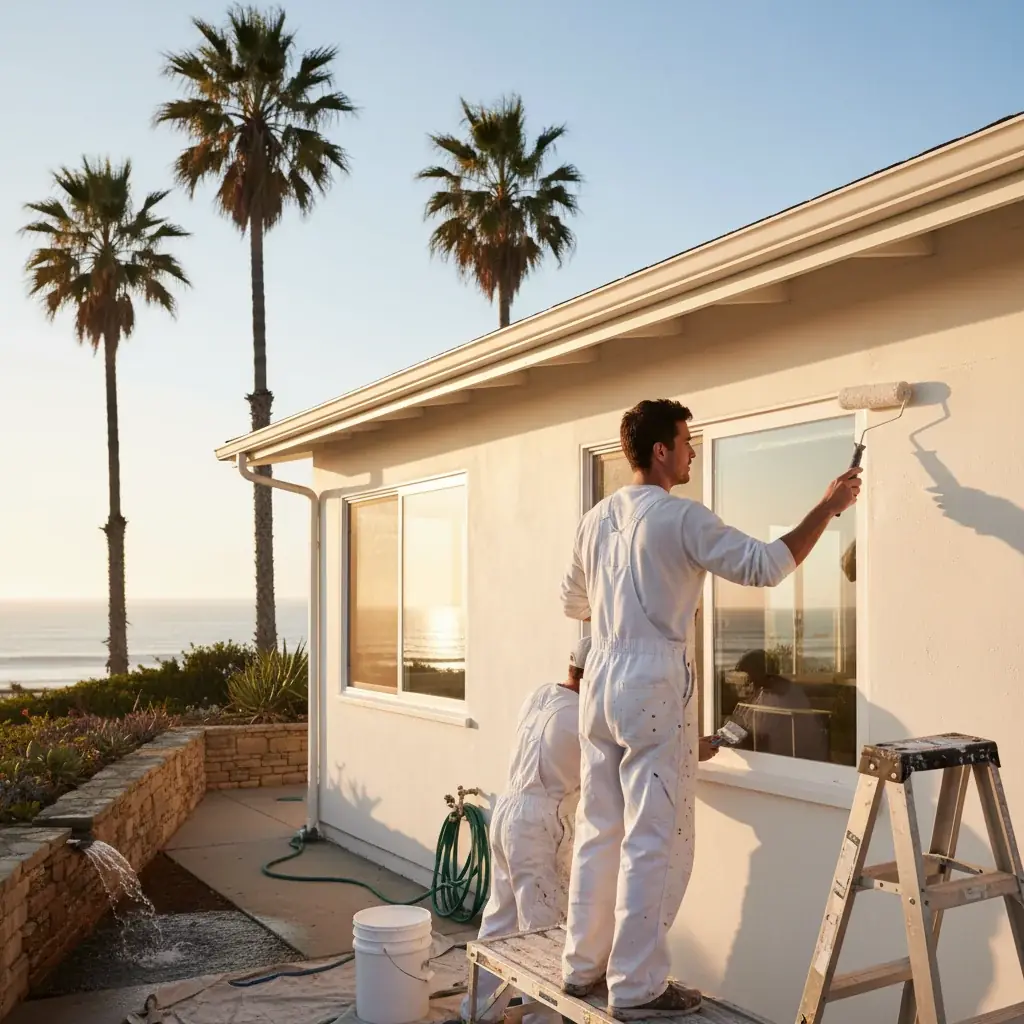
What Encinitas weather does to exterior paint
An Encinitas paint job isn’t just fighting one enemy, it’s fighting three: sun, salt, and moisture. Understanding how they work together is the key to choosing a finish that protects your home.
First, the sun. San Diego County gets nearly 3,000 hours of sunshine a year. That constant UV radiation is brutal on paint. It breaks down the binders that hold the pigment together, causing colors to fade and the surface to develop a chalky film. South and west-facing walls take the most abuse, often showing wear years before the rest of the house.
Next is the salt. The marine layer isn’t just cool fog; it’s a suspension of microscopic salt crystals carried in from the ocean. This salty mist settles on every surface of your home. Salt is hygroscopic, meaning it attracts and holds water. This constant, low-level moisture, combined with the corrosive nature of salt, works its way into any tiny crack or weak point in your paint, causing it to bubble, blister, and peel away from the stucco or wood underneath.
Finally, there’s the moisture. Between the dense morning fog and our winter rain, homes here see a lot of water. If the paint film is compromised by sun and salt, this moisture can penetrate the substrate. On stucco, this can lead to efflorescence (white, powdery mineral deposits) and cracking. On wood trim, it leads to rot. A proper exterior painting job in Encinitas acts as a sealed, protective envelope against all three of these elements.
Salt air zones: Leucadia, Cardiff, Olivenhain differences
Not all of Encinitas experiences the coastal effect equally. Where your home is located, even just a mile or two inland, dramatically changes the demands on your exterior paint. We think of the city in three distinct zones.
The Front Line: Leucadia and Cardiff-by-the-Sea If you live west of I-5, especially along the 101 corridor, your home is on the front line. The salt spray here is a constant presence. You can taste it in the air and see its residue on your windows. For homes in Cardiff and Leucadia, paint failure happens faster. We see more significant peeling, corrosion on metal railings and light fixtures, and faster color fading. The prep work here has to be meticulous, with an emphasis on power washing to remove all salt deposits and using primers that are specifically designed for coastal conditions.
The Coastal Zone: Central Encinitas
Homes east of I-5 but west of El Camino Real are still firmly in the coastal zone. While you’re spared the direct salt spray, the marine layer is a daily reality. Salt is still being deposited on your home, just at a slower rate. The challenges are the same as on the coast, sun, salt, and moisture, but the timeline for repainting is often a bit longer. The focus for an encinitas house painter in neighborhoods like this is still on high-quality, salt-resistant materials, but the urgency might be slightly less severe than for a home overlooking Swami’s.
The Inland-Coastal Blend: Olivenhain and Encinitas Ranch As you move further east into areas like Olivenhain, the immediate coastal effects lessen. The air is drier and the salt concentration drops. However, these areas face a different blend of challenges. The sun can be more intense without the thick morning fog to block it, accelerating UV damage. These more inland areas also see greater temperature swings, which cause building materials to expand and contract, putting stress on the paint film. While salt is less of a concern, durability and flexibility in the paint are still paramount.
Stucco prep before paint goes on
For the vast majority of Encinitas homes, the exterior surface is stucco. You can apply the best paint in the world, but if the stucco underneath isn’t properly prepared, the job will fail in a few short years. Proper prep is 80% of a successful and long-lasting paint job.
The process starts with a thorough pressure wash. This isn’t just about making the house look clean. It’s a critical step to remove years of built-up dirt, grime, mildew, and, most importantly, corrosive salt residue. We use the appropriate pressure to clean the surface without driving water into the stucco or damaging its texture.
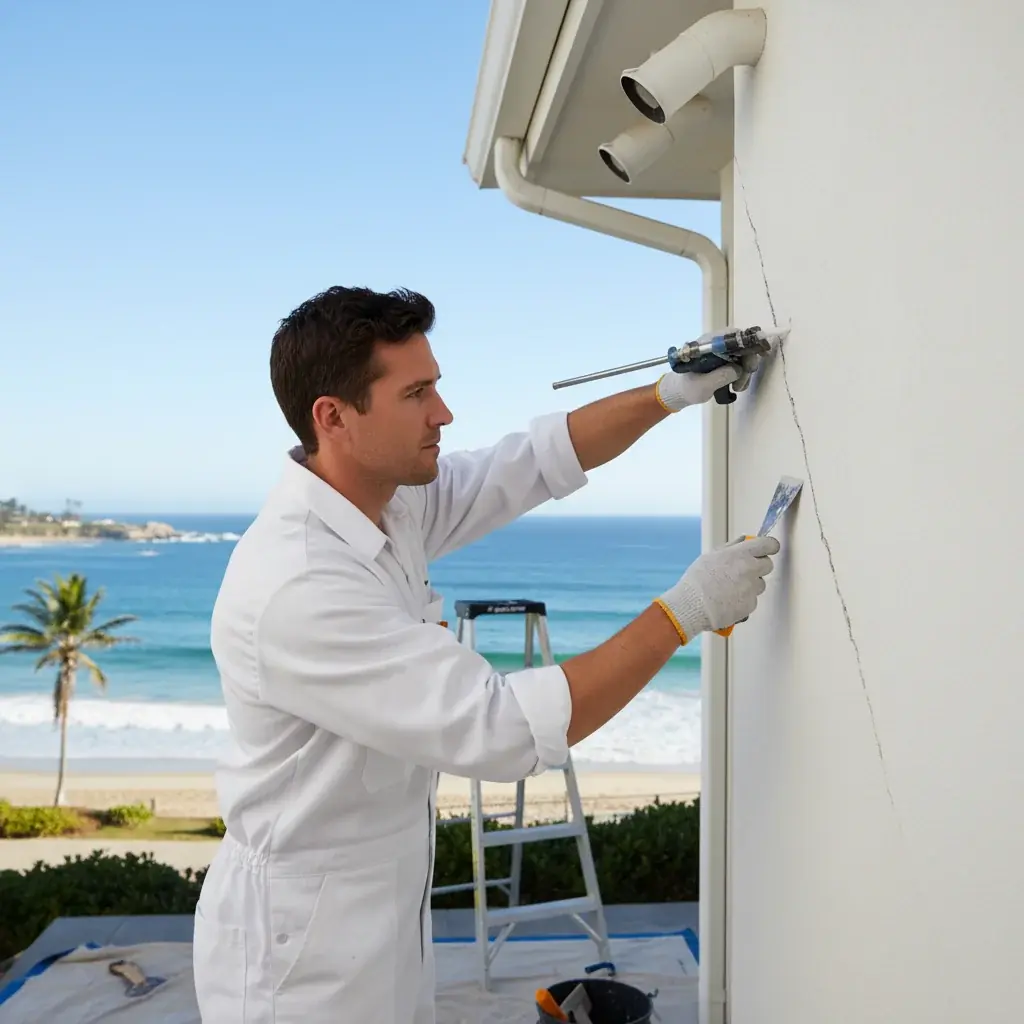
Next comes a detailed inspection of every wall. We walk the entire perimeter, looking for any and all imperfections. We’re searching for hairline cracks, which are common as a house settles, as well as larger structural cracks. We also look for any areas where the stucco feels soft, is bubbling, or is pulling away from the wall (delamination).
Repairing these issues is non-negotiable. Hairline cracks are filled with a high-quality elastomeric caulk that remains flexible to move with the house. Larger cracks are often “V’d out” with a grinder to create a channel, then filled with a professional-grade stucco patching compound and re-textured to match the surrounding finish. This dedicated stucco painting and repair work ensures the surface is sound before any primer or paint is applied. Finally, we apply a masonry sealer or conditioner, especially over patched areas or chalky surfaces, to ensure the new paint has a perfect surface to bond to.
Products that hold up: Evershield, Emerald, Resilience
The product choice for a coastal home is critical. Using a cheap, low-grade paint is a guaranteed way to be repainting again in just a few years. We primarily rely on a handful of proven, high-performance acrylic latex paints that are specifically formulated to withstand the coastal environment.
Dunn-Edwards Evershield: This is a fantastic workhorse for Southern California homes. It’s a 100% acrylic paint known for excellent adhesion, durability, and color retention under intense sun. It also contains additives that resist mildew growth, which is a big plus in our damp, foggy mornings. Evershield provides a tough, long-lasting finish that holds up well against salt and moisture.
Sherwin-Williams Emerald Exterior Acrylic Latex: Emerald is a top-of-the-line product, and for good reason. It offers exceptional resistance to blistering, peeling, and fading. Its self-priming properties on previously painted surfaces can streamline the process, and its coverage is fantastic. For a homeowner in Cardiff or Leucadia who wants the maximum possible lifespan from their paint job, Emerald is often the best choice.
Sherwin-Williams Resilience Exterior Acrylic Latex: The standout feature of Resilience is its ability to handle moisture during the curing process. It’s formulated to resist moisture in as little as one hour. This is a huge advantage for an encinitas painting contractor working during “May Gray” or “June Gloom,” as it reduces the risk of a sudden marine layer or fog ruining a freshly painted wall. It offers great durability and hide, making it a reliable choice for our specific climate.
The right product always depends on the specific home, its condition, and the homeowner’s budget. But starting with one of these three high-quality options is essential for a paint job that lasts.
Repaint cycles for coastal Encinitas homes
“How long will my paint job last?” It’s the most common question we hear, and the answer depends almost entirely on location, preparation, and product quality. A cheap paint job done with poor prep might look good for a year, but it will fail quickly. A professional job using top-tier materials will last for years.
Here are some realistic timelines for a high-quality exterior paint job in Encinitas:
-
West of I-5 (Leucadia, Cardiff): In this high-salt, high-moisture zone, you should expect to repaint every 5 to 7 years. The constant assault from the elements simply wears down the paint film faster here than anywhere else. South and west-facing walls will almost always be the first to show signs of fading or failure.
-
East of I-5 to El Camino Real (Central Encinitas): With slightly less direct salt exposure, the repaint cycle can often be extended. For homes in this area, a quality paint job will typically last 7 to 10 years. Regular, gentle washing once a year to remove surface grime and salt can help push it toward the longer end of that range.
-
Olivenhain & Encinitas Ranch: In these more inland areas, the primary enemy is the sun. A paint job can last 8 to 12 years, but the key is using a paint with excellent UV inhibitors. Darker colors will fade faster than lighter, more reflective colors, which can shorten the lifespan of the paint’s appearance, if not its protective qualities.
These are just general guidelines. The condition of your home before painting and the quality of the work performed are the most important factors. Any contractor you consider should be properly licensed; you can verify their C-33 painting license on the CSLB website.
HOA color rules in common neighborhoods
Many of Encinitas’s most desirable neighborhoods are planned communities with active Homeowner’s Associations (HOAs). While HOAs help maintain property values, they often have very strict rules about exterior paint colors. You can’t just choose any color you like from the hardware store.
Neighborhoods like Encinitas Ranch, for example, have a pre-approved palette of colors. These palettes are carefully curated to create a harmonious, cohesive look throughout the community, often consisting of earthy tones, warm beiges, soft whites, and muted greens that complement the coastal landscape.
The process for painting in an HOA community requires extra steps. First, you must obtain the approved color palette from your HOA’s architectural committee. Once you’ve selected a color scheme from that list, you typically have to submit an application showing which colors you’ll use for the body, trim, and accents. The committee must approve your plan in writing before any work can begin.
Navigating this process can be frustrating for homeowners. That’s why we offer comprehensive HOA painting services that include managing this approval process. We’re familiar with the palettes and procedures for many Encinitas communities and can help ensure your project gets approved without delays. For a deeper dive into the specifics, you can read our guide on how to get HOA paint approval.
When to call us
If your Encinitas home is showing signs of coastal wear, or if you’re navigating the complexities of an HOA color change, it’s time to call a professional. We handle the detailed prep and product selection that coastal homes demand. Call us at (858) 925-5546 for a same-day estimate.