A full exterior repaint in San Diego runs $3,500 to $9,000 for a typical single-family home in 2026, takes 5 to 10 working days start to finish, and lasts 7 to 15 years depending on which side of the 15 freeway you live on. The work isn’t just paint on a wall. It’s pressure washing, scraping, hairline-crack repair, wood replacement, masking, two coats of the right paint chemistry for your microclimate, sealant pass, and a final touch-up walk. This is the hub guide. For pricing detail, see our exterior painting cost guide for San Diego. For everything else, keep reading.
Call (858) 925-5546 for a free Paint Pros San Diego exterior estimate, or visit our exterior painting service page for the short version.
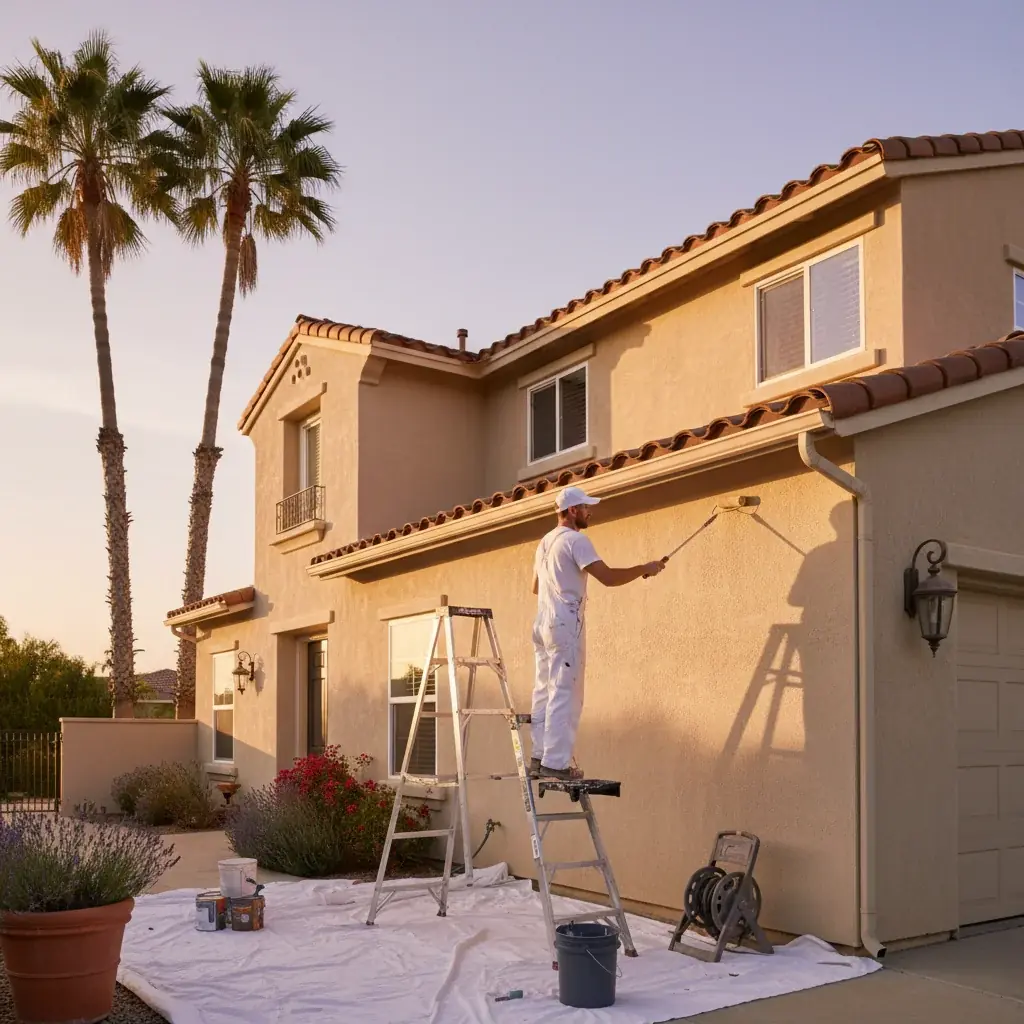
What an exterior painting service in San Diego actually includes
A real exterior repaint isn’t a one-day spray job. The work is mostly prep. Here’s what every legitimate San Diego exterior service should cover before the first finish coat goes down.
Pressure washing the entire envelope. Stucco, siding, fascia, soffits, trim, gutters, garage doors, the front entry. A 3,000 PSI cold-water wash with a fan tip clears the chalking, salt film, dust, and biological growth that block paint adhesion. Coastal homes within a mile of the water (La Jolla, Pacific Beach, Mission Beach, Cardiff, Solana Beach, Del Mar, Encinitas) typically need a second pass with a low-pressure mildewcide rinse because of the marine layer biology that lives in the texture grooves.
Scrape, sand, and grind. Any failed paint film gets scraped to a hard edge and feathered. Soft wood gets dug out and either replaced or filled with a two-part epoxy. Loose stucco gets knocked back to a solid edge.
Crack and substrate repair. Hairline stucco cracks (the spider-web stuff that opens up after Santa Ana cycles) get bridged with elastomeric patching compound or a flex-grade caulk. Larger structural cracks need a stucco patch with bonding agent and a re-texture match. Wood trim with dry rot gets replaced.
Masking and protection. Windows, light fixtures, address numbers, plants, walkways, AC condensers, solar conduits, security cameras. A full mask takes a real crew most of a day on a 2,200-square-foot home.
Primer where it’s needed. Bare wood, raw stucco patches, water-stained fascia, oxidized metal flashing, and any patch over a different color all get primed. A bonding primer (Zinsser 1-2-3, Sherwin-Williams ExtremeBond) goes on chalky old stucco. Skipping primer in those zones is the most common reason a finish fails inside three years.
Sealant pass. Around windows, doors, where stucco meets wood trim, where fascia meets soffit, where two siding materials meet. We use a 50-year urethane sealant (Sika 1A or OSI Quad Max) instead of the cheap 25-year acrylic caulk most contractors default to. The difference at the bid stage is about $80 in material and saves you a callback in year 8.
Two finish coats on the field. One coat is a touch-up. Two coats are a paint job. Most reputable San Diego contractors will write “two-coat application” directly into the proposal. If you don’t see it in the contract, ask why.
Trim, fascia, soffits, gutters, garage door. These get their own coats in their own color (usually a contrasting trim color). Garage doors and entry doors often need a third coat for a true even finish, especially in dark colors over a previously light-colored door.
Final sealant and detail touch-up. A walk with the homeowner, a punch-list pass, and a final caulk touch on anywhere that shrank back as the paint cured.
The rule of thumb: if a contractor’s bid skips line items for masking, primer, sealant, or two coats and just gives you a lump sum, you’re not comparing the same job to anyone else’s bid.
Paint type selection for San Diego exteriors
Picking the wrong paint chemistry for your microclimate is the single biggest reason exterior finishes fail early in San Diego County. Here’s the decision tree we walk every customer through.
100% acrylic latex for most San Diego homes. This is the workhorse. Sherwin-Williams Resilience or Emerald, Benjamin Moore Aura Exterior, Dunn-Edwards Evershield. Acrylic flexes through SD’s diurnal temperature swing (40-degree daily delta in inland zones during Santa Ana season), breathes so it doesn’t trap stucco moisture, and resists UV from our 263 sunny days per year. Expected lifespan: 10 to 15 years inland, 7 to 12 years coastal. Sherwin-Williams publishes performance specs for Emerald Exterior and Resilience Exterior that we hold our crews to.
Elastomeric only for hairline-cracked stucco. Elastomeric paint stretches 200% to 300% before it tears. That sounds great until you understand the tradeoff: elastomeric also has a thicker film, doesn’t breathe as well, and traps water vapor against the substrate if applied over wet stucco. Use it only when the stucco has documented hairline cracking and you’ve verified the substrate is dry. For most San Diego homes, the right answer is acrylic over crack-bridging caulk, not full elastomeric. We cover the full decision in our elastomeric vs acrylic for stucco guide.
Oil or alkyd for trim and entry doors. Trim takes the most abuse: door knocks, hose spray, gardener weed-whacker hits, kid scuffs. An oil-modified alkyd enamel (Benjamin Moore Advance, Sherwin-Williams ProClassic Alkyd) levels glass-smooth and resists chipping better than latex enamel on doors and shutters. Modern water-based alkyds are VOC-compliant for California under SCAQMD Rule 1113 limits and clean up like latex.
Marine-grade paint for coastal salt-air homes. Homes within 500 feet of the water (Sunset Cliffs, Ocean Beach, Mission Beach, Pacific Beach, La Jolla Shores, Bird Rock, Cardiff, Del Mar Bluffs) take salt-spray exposure that eats standard exterior paint film in 4 to 6 years. We spec Sherwin-Williams Loxon XP or Dunn-Edwards Evertone with a corrosion-inhibiting primer on any metal flashing or railings. For homes on a true bluff lot, we’ll sometimes step up to a marine coating like Sherwin-Williams Macropoxy 646 on metal elements only.
Skip the cheap stuff. Behr Marquee from Home Depot is fine for a small DIY shed paint or a back-yard fence. For a 2,500-square-foot stucco repaint that has to last a decade in coastal SD humidity and UV, the formula doesn’t hold up the way a pro-grade Sherwin-Williams, Benjamin Moore, or Dunn-Edwards product does. The material savings (maybe $400 across the whole job) shave 3 to 5 years off the repaint cycle.
San Diego microclimate zones and how they affect exterior paint
San Diego County has at least five distinct microclimates within a 60-mile drive. Each one has a different impact on how exterior paint performs. NOAA tracks our regional climate data, and the Climate.gov San Diego climatology page shows the swings clearly.
Coastal zone (everything west of the 5 from Imperial Beach to Oceanside). Marine layer humidity sits at 70% to 85% relative humidity from May through July, sometimes into August. Salt air carries chloride ions that corrode metal and degrade paint binders. Direct UV is moderate, but the salt-fog-then-sun cycle is brutal on south- and west-facing walls. Repaint cycle: 7 to 10 years. Spec: 100% acrylic with a corrosion-inhibiting primer on metals, marine-grade sealants. NOAA tracks our regional marine layer climatology at the NOAA San Diego Climate Page.
Inland valley (Mira Mesa, Kearny Mesa, Tierrasanta, Linda Vista, Mission Valley, Lemon Grove). Hotter than coastal by 10 to 15 degrees in summer. UV is intense. Humidity moderate (45% to 60% summer average). Repaint cycle: 10 to 13 years on the south and west elevations, 12 to 15 on north and east. Spec: standard 100% acrylic. This is the easiest zone to paint in San Diego.
East County and the inland valleys (El Cajon, Santee, Lakeside, Alpine, Ramona, Jamul). Dry heat. UV is the highest in the County. Santa Ana wind cycles drop humidity to under 15% and push temperatures into the high 90s twice a year. Stucco hairline cracks open and close with the heat cycle. Repaint cycle: 10 to 15 years if you bridge the cracks correctly at the prep stage. Spec: 100% acrylic with flex-grade caulk in hairline cracks, UV-stable pigments only (avoid bright reds and blues that fade fastest).
Mountain communities (Julian, Pine Valley, Mt. Laguna, Palomar, Descanso). High UV at elevation. Snow and freeze-thaw cycles a few times per winter. Wider temperature swings. Repaint cycle: 8 to 12 years. Spec: an exterior acrylic rated for freeze-thaw cycling, with extra attention to wood substrate sealing.
Border zone (Chula Vista, National City, Otay Mesa, San Ysidro, Bonita). Warmer than coastal. Lower marine humidity. Some industrial particulate near the border crossing. Repaint cycle: 10 to 13 years. Spec: standard 100% acrylic with a low-VOC formula required by South Bay air-district rules.
The practical implication: a contractor giving you the same paint spec for a Coronado bayfront and a Ramona ridgeline isn’t actually thinking about your house. Ask which products they spec for your specific ZIP and why.
When to repaint your exterior in San Diego
The honest answer: when the paint film starts failing, not on a fixed calendar. Here are the realistic intervals by zone, and the signs that move you up the schedule. For deep detail on this question, see how long does exterior paint last in San Diego and how often to repaint stucco in San Diego.
| Zone | Typical repaint cycle |
|---|---|
| Direct coastal (within 500 ft of water) | 6 to 9 years |
| Coastal (within 1 mile of water) | 7 to 10 years |
| Inland valley | 10 to 13 years |
| East County dry heat | 10 to 15 years |
| Mountain (Julian, Pine Valley) | 8 to 12 years |
These ranges assume a quality 100% acrylic was used last time and the prep was real. If the last paint job was a single-coat budget service, cut the range by 30% to 40%.
Five signs your San Diego exterior needs repainting now
If you see any two of these, get a bid.
1. Chalking. Run your hand across a south or west wall. If a chalky residue comes off on your palm, the paint binders have UV-degraded and the film is no longer protecting the substrate. Common in inland and East County after year 8.
2. Color fading. Especially on south- and west-facing walls. Compare a sun-exposed area to a shaded north-side or under-eave area. If the difference is more than two shades, the pigments are spent and water is no longer beading off properly.
3. Peeling, blistering, or alligatoring. These are different problems with the same root cause: paint film has lost adhesion. Peeling on stucco usually traces to moisture intrusion (a sprinkler hitting the wall, a roof leak above, or a foundation moisture issue). Blistering on wood usually traces to sun-side heat over insufficient primer.
4. Hairline cracks in stucco. Spider-web cracks under 1/16 of an inch are normal in San Diego stucco. They’re not structural. But once they appear, water can wick into the cement substrate and accelerate paint failure on the next sun cycle. The fix is a repaint with crack-bridging caulk and an elastomeric patch where the cracks are dense. We cover this in common stucco problems in San Diego and the deeper exterior paint prep on stucco guide.
5. Efflorescence. White crystalline deposits on stucco. This is salt and mineral migration to the surface, driven by moisture inside the wall. It’s a sign you have a water issue, not just a paint issue. A repaint without fixing the source is paint over a wet wall, which fails in 18 to 36 months.
Color trends and HOA-safe palettes for 2026
San Diego color preferences in 2026 are running warm. The slate-gray-everything wave that dominated 2018 to 2022 has cooled. What’s selling well right now across SD County HOAs and design-conscious neighborhoods:
Warm whites and soft creams. Sherwin-Williams Alabaster, Benjamin Moore White Dove, Dunn-Edwards Swiss Coffee. They read as fresh without looking sterile, and they pass nearly every HOA palette in SD County.
Sage and muted greens. Sherwin-Williams Evergreen Fog (Color of the Year 2022, still strong), Benjamin Moore October Mist, Dunn-Edwards Evershield exterior colors in their sage range. Looking great against San Diego’s drought-tolerant landscaping.
Terracotta and warm earth tones. Pulled from our mission and adobe heritage, these are appearing on accent walls, garage doors, and front entry doors. Restrained, not full-elevation. Sherwin-Williams Cavern Clay reads particularly well on Spanish-revival exteriors.
Deep blue and slate as accent colors. Sherwin-Williams Naval, Benjamin Moore Hale Navy. Used on entry doors and shutters, not full-field. Most HOAs approve these as accents but not as field colors.
HOA-safe rule of thumb. Most San Diego HOAs publish a pre-approved palette of 18 to 40 colors. The safest field colors are warm whites, soft greys with a warm undertone, soft beige, and sandstone. The riskiest submissions are saturated jewel tones, pure black, and any “cool blue grey” that reads photographic but not architectural. Always submit before you paint, even if the color “looks close” to a neighbor’s. We walk through the full submission process in our HOA exterior paint approval guide and the HOA paint color rules guide for San Diego. The Benjamin Moore Aura Exterior color collection is a good starting place because most HOA palettes draw from BM and SW codes directly.
For more color direction, see our roundup of popular exterior house paint colors in San Diego.
Process and timeline for a San Diego exterior repaint
Here’s what a real 7-day exterior schedule looks like on a 2,200-square-foot stucco home with a tile roof.
Day 1: Pressure wash and prep walk. A two-person crew washes the full envelope. Foreman walks the perimeter, marks the substrate repairs, and orders any wood or trim replacement parts.
Day 2: Substrate repair and crack work. Hairline crack bridging, wood replacement, stucco patching, dry rot repair. Patches dry overnight.
Day 3: Masking. Windows, doors, light fixtures, plants, walkways. Plastic on big shrubs, drop cloths on hardscape. This is the most time-consuming labor day.
Day 4: Primer and first coat. Spot-prime any bare substrate. Spray and back-roll the first coat of field color on stucco. Brush and roll on textured siding. Bigger crew this day (3 to 4 painters).
Day 5: Second coat field. Second coat on the body. Cut-in trim lines. Detail work around features.
Day 6: Trim, fascia, soffits, doors, gutters. Trim color goes on every accent surface. Garage door if it’s a different color. Entry door often gets a third coat.
Day 7: Sealant pass, touch-ups, demask, final walk. Walk the perimeter with the homeowner, mark anything needing a touch-up, address it on the spot. Pull all masking. Clean up. Final invoice.
Larger homes (over 3,500 square feet), multi-story, or homes with extensive wood trim push this to 9 or 10 days. Smaller ranch homes (1,200 square feet) can finish in 4 to 5 days.
San Diego-specific exterior painting challenges nobody else writes about
National articles about exterior painting miss the things that actually break paint jobs in San Diego. Here’s what we see on the ground.
Marine layer slows dry time dramatically. Coastal jobs in May, June, and July run at 75% to 85% relative humidity until around 11 a.m. A paint manufacturer’s “recoat in 4 hours” spec stretches to 6 or 7 hours on those mornings. Crews that don’t adjust their schedule get film cure failures: blocking on doors, lap marks on big stucco walls, soft film that picks up gardener-debris within a week. Our scheduling rule for coastal zones is: stucco gets sprayed after 10 a.m., trim work happens in the afternoon, no door painting before noon.
Salt-air corrosion on coastal metals. Metal flashing, gutters, rain chains, exposed conduit, garage door panels, and address-number plaques within a mile of the water need a corrosion-inhibiting primer (Rust-Oleum 769 or Sherwin-Williams Pro-Cryl) before the finish. Skip the primer and you’ll see rust bleed through your new white paint inside 18 months.
Fire-safe construction versus aesthetic finish in East County. Homes in East County and the mountain communities (Alpine, Ramona, Julian, Descanso, Pine Valley) are increasingly built or retrofit to California’s WUI (Wildland Urban Interface) code. Eaves are boxed, vents are ember-resistant, siding is fiber cement or stucco. Some homeowners want the rustic wood-siding look those builds replaced. Modern exterior paint can absolutely give fiber cement a real wood appearance with the right primer and a multi-coat warm-toned finish, but if you’re pushing for a deep stain look on wood substrate in a WUI zone, talk to your insurance carrier first. The state’s CAL FIRE WUI guidance covers the rules. Some homeowner insurance carriers in fire zones now require Class A fire-rated exterior coatings.
Santa Ana events break paint schedules. Twice a year (typically October and April) we get Santa Ana wind events with humidity under 15% and temperatures hitting the high 90s. Painting during a Santa Ana means the film flashes too fast, gets sand-blasted by the wind, and ends up with orange-peel texture or visible lap marks. Reputable San Diego crews watch the seven-day forecast and will push your start date a week if a Santa Ana is rolling in.
Stucco moisture from old irrigation. Sprinkler systems installed in the 1980s and 1990s often hit the bottom 24 inches of stucco walls every day. That keeps the substrate constantly damp. Painting over chronically wet stucco fails within 36 months. The fix is to redirect or cap the sprinkler before painting, then let the substrate dry for 14 days minimum before starting. We pressure-wash, then we test with a moisture meter (Tramex Wet Wall meter) before we’d ever spray primer.
Older shake-shingle siding in north-central neighborhoods. Homes in Rancho Penasquitos, Scripps Ranch, and parts of Tierrasanta built in the 1980s have cedar shake or T1-11 wood siding. These need a different approach: a penetrating oil-modified primer on weathered wood and a flexible acrylic top coat. Standard latex over old shakes flakes off in 4 years. The American Wood Council publishes good substrate guidance through the APA Engineered Wood Association.
Frequently asked questions about exterior painting in San Diego
How long does exterior paint last in San Diego? Realistically: 7 to 10 years in coastal zones, 10 to 15 years inland and East County, and 6 to 9 years for homes within 500 feet of the water. That’s with a 100% acrylic spec and real prep. Cheap single-coat work cuts those ranges by 30% to 40%. See our deep dive on how long exterior paint lasts in San Diego.
Can you paint during the marine layer or June Gloom? Yes, but the schedule has to flex. Most coastal SD jobs start the stucco work after 10 a.m. once the humidity has dropped under 65%, and we stop spraying by mid-afternoon to give the second coat enough cure time before the evening moisture rolls back in. Painting at 8 a.m. in June on a coastal home is how you get blistering and lap marks.
What’s the best month to paint a house exterior in San Diego? September and October are statistically ideal: low humidity, stable temperatures, no Santa Ana risk yet, no marine layer. April and May are good runners-up. June through August is workable on inland and East County homes but the marine layer slows coastal jobs significantly. Avoid December and January, when our cooler nights drop below the 50-degree minimum cure temperature for most acrylics. See our full breakdown of the best time to paint exterior in San Diego.
Do I always need primer on an exterior repaint? Not the whole house. You need primer on bare substrate (new wood, new stucco patches, water-stained fascia, oxidized metal), on chalky old paint, and anywhere you’re going from a darker color to a much lighter color. On a sound, same-color repaint over a 7-year-old acrylic finish, primer isn’t required everywhere, just on the spot repairs. A contractor who insists on full-house primer on a sound substrate is padding the bid. A contractor who skips primer on a chalky stucco is setting you up for failure in year 3.
Can I dramatically change my home’s color from dark to light, or light to dark? Yes, but plan for an extra coat. Going from a deep navy to a warm white usually takes a tinted primer plus three finish coats to get full coverage and color depth. Going from white to charcoal needs a grey-tinted primer and two coats. Either way, factor an extra $400 to $900 into the bid for the additional material and labor. If your HOA is involved, also factor in the approval timeline (often 2 to 6 weeks).
What kind of warranty should an exterior paint job have in San Diego? A reputable San Diego painting contractor stands behind labor for 3 to 7 years, and the paint manufacturer’s product warranty covers materials separately (Sherwin-Williams Emerald is 25-year limited, Benjamin Moore Aura is lifetime limited). Real warranty includes touch-ups for adhesion failures within the labor warranty period at no charge. Watch for warranties limited to “manufacturer defects only,” which exclude almost every realistic failure mode (improper prep, weather-related failure, substrate movement). Ask for the labor warranty in writing in the contract.
How much does exterior painting cost in San Diego? A single-story 2,000 sqft stucco home runs $7,500 to $14,000 with full prep and a premium acrylic. Two-story homes run $10,000 to $20,000. Wood or fiber-cement siding runs 10 to 20 percent less on the same footage. Elastomeric coatings add 15 to 25 percent. Coastal homes (Carlsbad, Encinitas, La Jolla, Coronado) add 10 to 20 percent on top of those ranges because of salt-air prep. See our exterior painting cost guide for the full breakdown.
How often should I paint my house exterior? Every 7 to 15 years in San Diego, depending on location. Coastal homes within 5 miles of the Pacific: every 7 to 10 years. Inland and East County: every 10 to 15 years. Homes within 500 feet of the water: every 6 to 9 years. Wood siding repaints more often than stucco. The visual signal is chalking, fading on south and west walls, and hairline crack networks.
What is the best time of year to paint a house exterior in San Diego? September and October are statistically ideal. Low humidity, stable temperatures, no Santa Ana risk yet, no marine layer. April and May are good runners-up. June through August is workable on inland and East County homes but slows coastal jobs because of morning marine layer. Avoid December and January when overnight temperatures drop below 50 degrees, which is the cure-temperature floor for most acrylic exterior paints.
How long does exterior painting take? A single-story 2,000 sqft stucco home runs 4 to 7 working days from pressure wash to final cleanup. Two-story homes run 7 to 14 days. Multi-color schemes, heavy crack repair, or HOA color approvals can add 2 to 5 days. Marine-layer mornings on coastal jobs push start times to 10 AM or later, which can stretch a 5-day job to 7.
Can you paint a house in one day? No, not in San Diego, not honestly. Paint manufacturers require minimum recoat times of 4 hours for most acrylics and longer in humid conditions. A real two-coat exterior job needs at least three days of physical paint application after the wash and prep work. Anyone promising a one-day exterior paint job is doing one coat, skipping prep, or both. You’ll see chalking and failure within 18 months.
How do you know when it’s time to repaint your house? Six signs in San Diego. Chalking on the surface (white powder when you rub it). Fading on south and west elevations. Hairline crack networks expanding on stucco. Mildew streaks on north-facing walls. Peeling around trim, windows, and door casings. Caulk lines failing along trim joints. Any two of those at the same time means start getting estimates. For lifespan detail, see our how long does exterior paint last post.
Get a real San Diego exterior painting estimate
A real exterior bid takes 45 to 60 minutes on site. We walk the full perimeter, document substrate condition, measure each elevation, check sun exposure, look at the irrigation pattern, identify HOA constraints, and email a detailed itemized quote within 24 hours.
Call (858) 925-5546 for a free Paint Pros San Diego exterior painting estimate. For pricing detail, see our exterior painting cost guide. For color direction, see popular exterior house paint colors in San Diego. For stucco-specific prep, see stucco painting in San Diego. For HOA homes, start with HOA paint color rules in San Diego and the exterior painting service page.
We service the full County: San Diego, La Jolla, Pacific Beach, Mission Hills, North Park, Mira Mesa, Carmel Valley, Del Mar, Solana Beach, Encinitas, Cardiff, Carlsbad, Oceanside, Vista, San Marcos, Escondido, Poway, Rancho Bernardo, Rancho Penasquitos, Tierrasanta, Clairemont, Chula Vista, National City, Bonita, La Mesa, El Cajon, Santee, Lakeside, Alpine, Ramona, Julian, Pine Valley, and the surrounding communities.