If you searched “painter near me” from a San Diego zip code, you’re already at the hardest part of the project. Picking the right painter is harder than picking the color, and a bad hire costs more than a good one. Here’s the short version: before you sign anything, verify the painter’s CSLB license at cslb.ca.gov, confirm active general liability insurance and a bond, ask for three local SD references with addresses, demand a written scope with paint brand and number of coats, and get a written warranty. Expect to pay roughly $3 to $7 per square foot of wall area for interior work and $1.75 to $4.50 per square foot of exterior surface for repaints, with cabinets and stucco priced separately. Call us at (858) 925-5546 if you’d rather skip the vetting step.
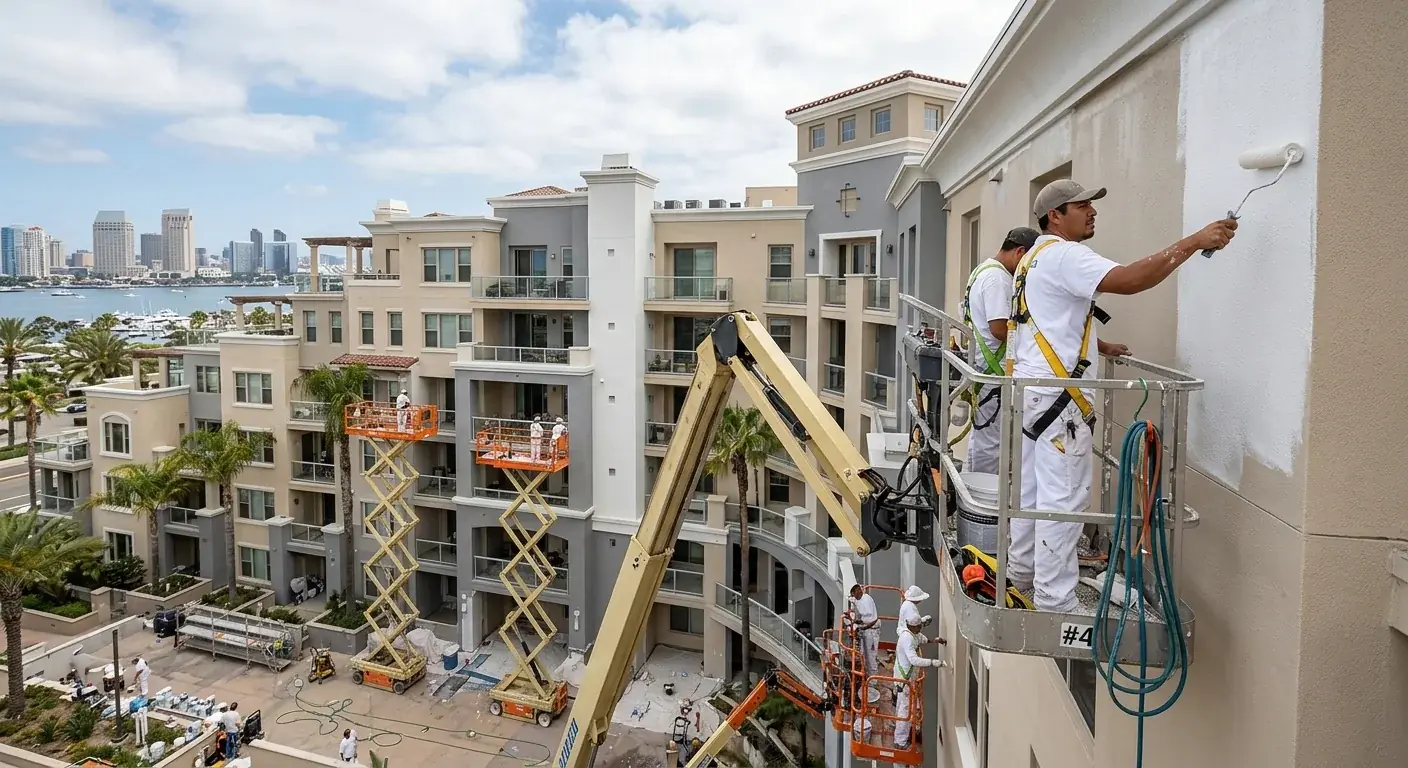
6 things to verify before hiring any San Diego painter
This is the non-negotiable list. If a painter can’t produce all six in writing within 24 hours of you asking, move on. The good news: when you call us at (858) 925-5546, we forward the lead to licensed subs who already pass these checks before they ever see your address. You can verify them yourself anyway, and you should.
1. Active CSLB license, Classification C-33 (Painting and Decorating). Every painter operating in California on a job over $500 must hold a current Contractors State License Board license. Look it up at cslb.ca.gov. You’re looking for active status, no recent suspensions, a $25,000 contractor bond on file, and workers’ comp coverage if the business has employees. If anything on the lookup is missing or flagged, walk away.
2. General liability insurance, proof in writing. Ask for a certificate of insurance (COI) showing at least $1 million in general liability, with your name listed as certificate holder. If something gets damaged during the job, this is the only thing standing between you and a small-claims fight. The state license requires a bond, not insurance, so a license alone is not enough.
3. Bonded status. California requires a $25,000 contractor bond for every licensed C-33. The bond is on file with CSLB and shows up in the license lookup. If a painter is operating without one, they’re operating without a license.
4. Three local San Diego references with addresses. Not “we did a job in La Jolla once.” You want cross-streets and the year for three completed jobs within 18 months, ideally within five miles of your zip code. SD County climate varies a lot between La Jolla and El Cajon, and a painter who works mostly inland may not understand salt-air prep for a coastal home. Drive by one or two if you can.
5. A written scope of work. Verbal estimates are worthless. The scope should specify: total square footage by surface (walls, ceilings, trim), paint brand and product line by name (Sherwin-Williams Emerald, Dunn-Edwards Evershield, Behr Marquee), sheen per surface, number of coats, primer use, prep work included, dates of work, daily start and stop times, and cleanup standard.
6. A written warranty. Two to seven years is the SD County range. Ask what the warranty actually covers (peeling, blistering, fading, adhesion failure) and what it excludes. A warranty that’s two paragraphs of marketing copy isn’t a warranty. One that names specific failure modes and a remedy is.
If verifying all of this on your own sounds like a part-time job, that’s because it is. Our value as a referral service is that we’ve already done it for the painters we forward to.
Red flags: walk away from any painter who does this
Some patterns show up over and over in CSLB complaint records and local Better Business Bureau filings. Treat the following as immediate disqualifiers.
Door-knockers. Reputable San Diego painters are booked out two to six weeks. They don’t have time to walk your block. The “we just finished a job around the corner and have leftover paint” pitch shows up in CSLB’s contractor scam alert almost every year.
Cash-only. A licensed business takes checks and cards. Cash-only means no paper trail, no recourse, and usually no workers’ comp or tax compliance.
“We’re in your neighborhood today” pressure. Compressed timelines kill due diligence. Any painter pushing you to sign within 24 hours is doing it because the math collapses under scrutiny.
No written estimate. “I’ll just send you a number” by text isn’t an estimate. Real estimates run two to four pages.
The leftover-paint discount. Same scam as the door-knock. The paint is either watered down, the wrong product line, or a discontinued color that won’t match your trim in two years.
No insurance. If they can’t email a COI within a business day, they don’t have one.
Large upfront deposit. California law caps the down payment on a home improvement contract at the lesser of $1,000 or 10% of the contract price (Business and Professions Code 7159). Anyone asking for 30% or 50% upfront is breaking state law. See CSLB’s “what you should know before you hire”.
No physical business address. PO box only, no office, no truck signage. Even sole proprietors have a real address on their license filing.
Hostility to questions. Good painters are used to getting asked about insurance, references, and warranties. If your questions trigger pushback or guilt-tripping, the answer is no, you shouldn’t.
How many quotes to get and what to compare
Get three. Not two, not five. Three is enough to spot an outlier (a quote 40% above the others usually means scope creep, and one 40% below usually means corners getting cut). Five gets you stuck in analysis paralysis and wastes the painters’ time.
Each of the three quotes should land within a few days of your initial call. They should arrive in writing, with the scope detail listed in the prior section. Compare them line by line, not on the bottom number. If quote A is $4,200 and quote B is $5,800, your first question should be: what’s different about the scope? Common answers: B includes two coats while A includes one. B includes primer on bare drywall while A doesn’t. B includes caulking and crack repair while A treats those as extras. B uses Sherwin-Williams Emerald ($75/gallon retail) while A uses a builder-grade product ($28/gallon).
The “price-only” comparison trap is the single most common SD homeowner mistake we see. Two quotes can be 30% apart and both be fair, because they’re not for the same scope. Always normalize the scope first, then compare price.
If you want a fuller breakdown by project type, see our house painting cost 2026 guide, our exterior painting cost guide for San Diego, and our interior painting cost guide for San Diego (the room-by-room version is at interior house painting cost room by room San Diego).
Questions to ask every painter on the walkthrough
Bring this list to the in-person estimate. Good painters will answer all of them in five minutes. Painters who hedge or get vague are telling you something.
What’s your prep approach? Listen for specifics: pressure washing PSI for exteriors, hand-scraping loose paint, sanding glossy surfaces, caulking trim and stucco cracks, spot-priming bare wood or stucco, masking floors and fixtures. Prep is 60-70% of a good paint job. A painter who can’t describe it in detail is a painter who doesn’t do it.
What primer do you use, and when? Bare drywall needs drywall primer. Bare wood needs a wood primer (stain-blocking on tannin-rich species like cedar or redwood). Bare or patched stucco needs an acrylic masonry primer. Stains need a stain-blocking primer like Zinsser BIN. “We just use the same paint as a primer coat” is wrong for any of those surfaces.
How many coats? Two finish coats is the SD County standard. Light over dark, or red, or deep blue, needs three. Anyone quoting one coat on a repaint is quoting a touch-up.
Weather-window policy? Good exterior painters don’t spray below 50°F or above 90°F surface temperature, don’t paint on wet substrate, and stop before evening dew. Ask what they do if the marine layer doesn’t burn off by 11am. Our best time to paint exterior San Diego guide walks through the seasonal calendar.
Color-change process? If you’re switching from beige to navy, ask for sample boards before they spray. Most reputable painters will paint a 3-foot test patch in two locations (sun and shade) and let you see it across a full day.
Day-by-day timeline. A two-story interior repaint typically runs 4-6 work days. An average SD exterior repaint runs 5-10 days depending on prep and home size. If a painter quotes two days for a full exterior, they’re cutting prep.
How to spot premium quality versus cut-rate work
The difference between a premium paint job and a cut-rate one is mostly invisible on day one. You see it 18 months in. Here’s what to look for during the walkthrough, and once they’re on site.
Caulking detail at trim. Premium painters caulk every joint between trim and wall, between trim pieces, and around windows. Caulk lines should be straight and thin, not visible as a fat bead. Cut-rate painters skip caulking or do it sloppily.
Primer on bare and stained spots. Watch the prep day. A premium crew spot-primes every bare patch, every filled nail hole, every water stain. Cut-rate crews paint over patches with the topcoat and the patches flash through visibly in raking light.
Drop cloth and tape discipline. Premium crews use canvas drops over plastic, tape every floor edge, and remove tape before the paint fully cures (so the line doesn’t tear). Cut-rate crews use plastic sheeting and leave tape on overnight.
Sprayer versus roller. Both have a place. Spraying is faster and smoother on stucco, cabinets, doors, and ceilings. Rolling gives better adhesion and a more durable film on wall surfaces. A premium crew sprays where spraying makes sense and back-rolls or rolls where rolling does. A crew that sprays everything is faster, not better. Most quality-conscious owners specify “spray and back-roll” on stucco.
Drying between coats. Premium painters respect the can’s dry time (usually 4-6 hours for water-based, longer in humidity). Cut-rate painters apply coat two while coat one is still tacky, which traps solvents and shortens the coating life by years.
If you want the deeper version of this, our professional interior house painting process San Diego and exterior paint prep stucco San Diego guides go step by step.
SD-specific hiring considerations
Hiring a painter in San Diego is different from hiring one in Phoenix or Seattle. Five things to know.
HOA approval timing. Most SD County HOAs require written board approval for exterior color changes. The approval cycle runs 2-6 weeks (some take 90 days). Start it before you collect quotes, because your color choice affects who can bid. See our HOA exterior paint approval and HOA paint color rules guides for the full process.
Marine layer weather windows. From May through July, coastal communities (Pacific Beach, La Jolla, Encinitas, Carlsbad, Coronado) see a marine layer that doesn’t burn off until 11am-1pm. Exterior painting effectively starts mid-morning during that stretch. Plan for slightly longer job duration on coastal homes.
Santa Ana season risks. October through early January, Santa Ana winds gust through East County and the inland canyons. Fresh paint plus dust plus high winds equals embedded grit. Reputable East County and Poway-area painters scrub the Santa Ana forecast before they spray.
Dust-and-ash season in East County. Late summer wildfire risk affects El Cajon, Alpine, Ramona, Julian, and back-country zips. Painters there will pause for air quality, and that pause needs to be in the contract.
Summer surface-temp limits. Inland SD (Escondido, Poway, Ramona, Santee) regularly hits 95°F+ in July and August. Stucco and metal in direct sun can hit 130°F surface temperature, well above the 90°F limit on most acrylic latex paints. Quality crews work the shaded side in the afternoon, then switch the next morning.
When to use a lead-gen referral service versus find your own
Being transparent: Paint Pros San Diego is a lead-gen referral service, not a painting company directly. We don’t dispatch our own crews. We maintain a vetted bench of licensed San Diego painting subcontractors, and when you call (858) 925-5546, we forward your project to the sub that best fits your zip code, scope, and timeline.
Why use a service like ours instead of finding your own painter? Three reasons. The vetting work (CSLB licenses, COIs, bond status, BBB records, reference checks) is already done. You get one response window instead of three voicemails and three call-backs over 7-10 days. And we hold the bench accountable: if a sub underperforms, we hear about it from the homeowner and that sub doesn’t get the next lead.
Why might you go direct instead? Two reasons. If a friend just had a great experience with a specific painter, hire that painter directly. We’re not pretending to know better than a fresh local reference. And if your project is unusual (historic restoration, lead-paint abatement, Venetian plaster, commercial scaffolding) you need a specialist. Our bench is residential repaint, cabinet, and HOA work. For everything else, see our best painters in San Diego 2026 guide.
When in doubt, call (858) 925-5546 and we’ll tell you honestly whether we’re the right path or whether you should call a specialist directly.
Frequently asked questions
How long should it take to get a quote? Initial response within one business day. Written estimate within 3-5 business days after the on-site walkthrough. If you’re 10 days in with no written number, that painter is telling you something about how they manage schedules.
What does a fair quote include? Total square footage by surface type, paint brand and product line by name, sheen by surface, number of coats, primer use, surface prep, dates of work, daily hours on site, payment schedule (max 10% or $1,000 down per California law), warranty terms, and cleanup standard. Two to four pages is normal.
Do you do free estimates? Yes. The painters on our bench provide free in-home estimates for jobs within their service area. Call (858) 925-5546 to start.
How do I check a painter’s license? Go to cslb.ca.gov and search by license number, business name, or owner name. You’re looking for active status, Classification C-33, no recent suspensions, a $25,000 bond on file, and workers’ comp coverage if they have employees.
What’s the best month to paint in San Diego? April, May, late September, and October are the best windows. Marine layer is shorter, humidity is moderate, and surface temps stay in the 60s and 70s. Avoid mid-July through August if you can (heat) and December through February for exteriors (cold nights and occasional rain). Our best time to paint exterior San Diego guide has the full month-by-month breakdown.
Can I supply my own paint? You can, but most reputable painters won’t warranty work done with customer-supplied paint, because they can’t verify the product, storage conditions, or batch. If you want a specific brand, ask the painter to spec and source it (they get contractor pricing, which usually washes out the difference) and have it listed by SKU on the contract.
What should you not say to a painter? Three things. Never share your budget before you’ve gotten three quotes (it anchors every bid to that number instead of the real scope). Never agree to a verbal scope (always written). Never agree to pay cash with no contract for a discount (it’s a tax evasion signal and you have no recourse if the work fails). Stick to scope, paint products, prep specifics, timeline, payment schedule, and warranty terms in every conversation.
How do I choose a good painter? Six checks in order. Verify the C-33 license is active at cslb.ca.gov. Read 20+ Google reviews looking for the words “communication” and “warranty.” Get three written quotes for identical scope. Compare paint brand, coat count, and prep specifics line by line. Pick the middle-priced quote if all three pass the first four checks. Confirm workers’ comp coverage in writing before signing.
Should you tip a painter? It’s not expected, and reputable painting companies don’t ask for tips. Tips are common at the end of a multi-week residential job where the same crew was in your home daily ($20 to $50 per crew member is typical for that scenario). On a 1 to 3 day job, tipping is uncommon. A Google review is worth more to most painters than a cash tip.
How much should you pay a painter upfront? No more than 10% or $1,000, whichever is less. That’s California law (CSLB rule) and it applies to every painting contract. A painter asking for 30% or 50% upfront is either operating illegally or signaling cash-flow problems that should make you walk. Standard San Diego payment schedules are 10% down, 40% at mid-project milestone, 50% at completion after final walk-through.
What do most painters charge per hour? Most reputable San Diego painters bill by the job, not the hour, because hourly billing rewards slow work. When pressed for an hourly equivalent, expect $55 to $90 per hour for a one-painter crew including materials, $120 to $200 per hour for a two-painter crew. Anyone quoting under $40 per hour without explaining the scope is almost certainly unlicensed, uninsured, or both.
How many quotes should I get for painting? Three. Two leaves you with no triangulation if one is unusually high or low. Four wastes everyone’s time. Get three written quotes for the exact same scope, on the exact same paint product, with the exact same prep description. If the three quotes are clustered within 15 percent of each other, pick the middle one. If one is dramatically lower than the other two, that’s the one to skip.
Next steps
If you’ve made it this far, you know more about hiring a painter than most San Diego homeowners ever bother to learn. The two-minute version: verify the license at cslb.ca.gov, get a COI, get three quotes with detailed written scopes, watch for the red flags, and ask the prep and primer questions.
Or call (858) 925-5546 for a free Paint Pros San Diego estimate and we’ll forward your project to a vetted licensed sub who’s already passed every check on the list above. Either path works. The one that doesn’t work is hiring the first quote that lands in your inbox.
Useful outside resources while you research:
- CSLB license lookup for verifying any California contractor
- CSLB contractor scam alerts for current fraud patterns
- CSLB “what you should know before you hire” including the 10% deposit cap
- BBB San Diego for accreditation and complaint history
- Angi hiring guide for painters for a national-level checklist
- HomeAdvisor “questions to ask a painter” for additional walkthrough prompts
- Diamond Certified painter ratings for SF-Bay-Area-style independent vetting (some companies operate in SD too)
- Sherwin-Williams contractor resources for product line specifications
- Dunn-Edwards painter directory for spec-trained SD contractors
- Behr Pro contractor program for product warranty terms
- See also our interior painting service page and exterior painting service page for our scope and process.
Call (858) 925-5546 for a free Paint Pros San Diego estimate.