Living in La Jolla means waking up to ocean views and coastal breezes. But that same environment that makes it a world-class place to live is incredibly harsh on your home’s exterior. The constant salt spray, intense sun, and damp marine layer can break down a typical paint job in just a few years, leaving your home looking tired and vulnerable. If you’re comparing crews county-wide, our hub of painters in San Diego County is a good starting point, and the exterior painting guide for San Diego covers the full coastal-tested workflow. If you’re comparing crews county-wide, our hub of painters in San Diego County is a good starting point, and the exterior painting guide for San Diego covers the full coastal-tested workflow.
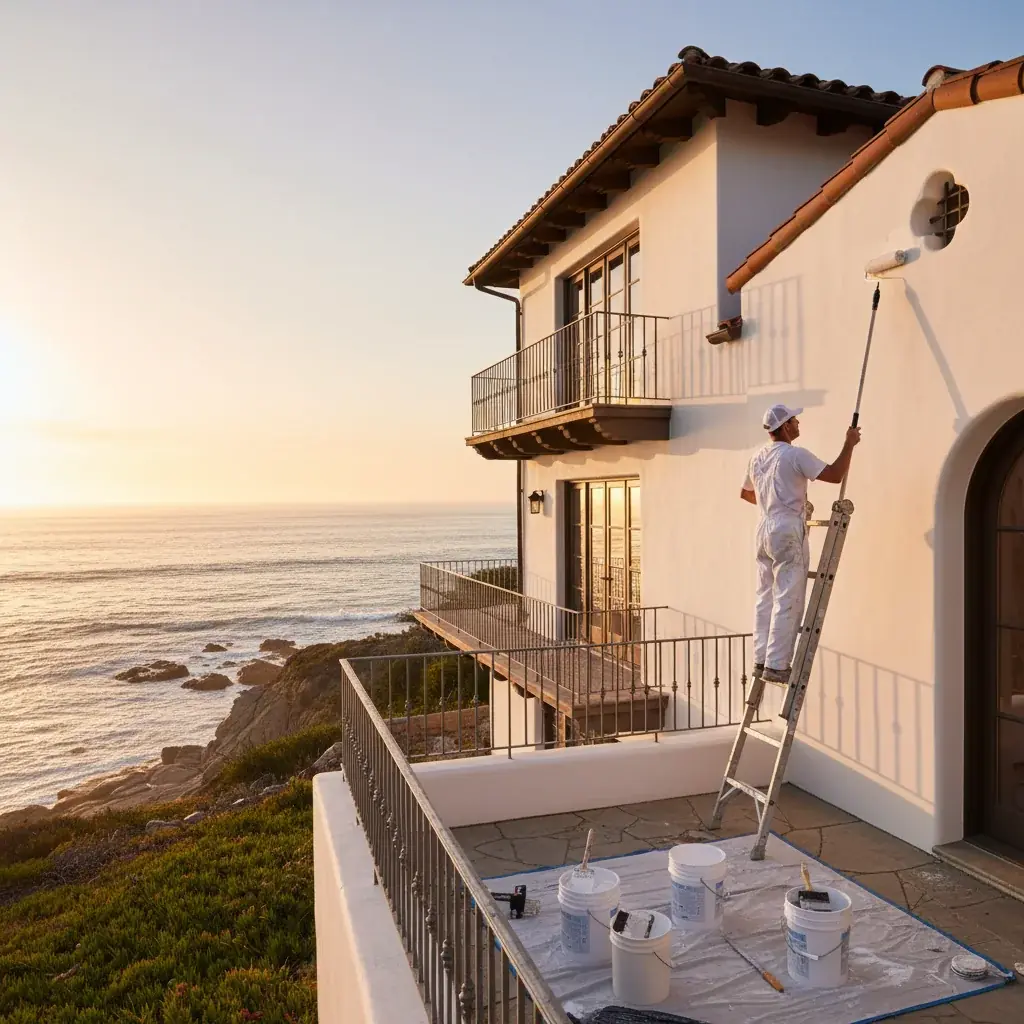
Choosing the right paint and, more importantly, the right process is not just about aesthetics. It’s about protecting your investment from the elements.
What salt air actually does to exterior paint
The gentle marine layer that rolls into La Jolla Shores and Bird Rock each morning carries microscopic salt crystals. When this moisture settles on your home’s exterior and then evaporates, it leaves behind a fine layer of salt. This is where the problems start.
Salt is hygroscopic, meaning it attracts and holds onto moisture. This constant dampness on your paint film creates a perfect environment for mildew and algae to grow, especially on north-facing walls that get less sun. Over time, it slowly breaks down the chemical binders that hold the paint together. The first sign of this is a process called “chalking,” where the paint surface degrades into a fine, powdery substance that rubs off on your hand.
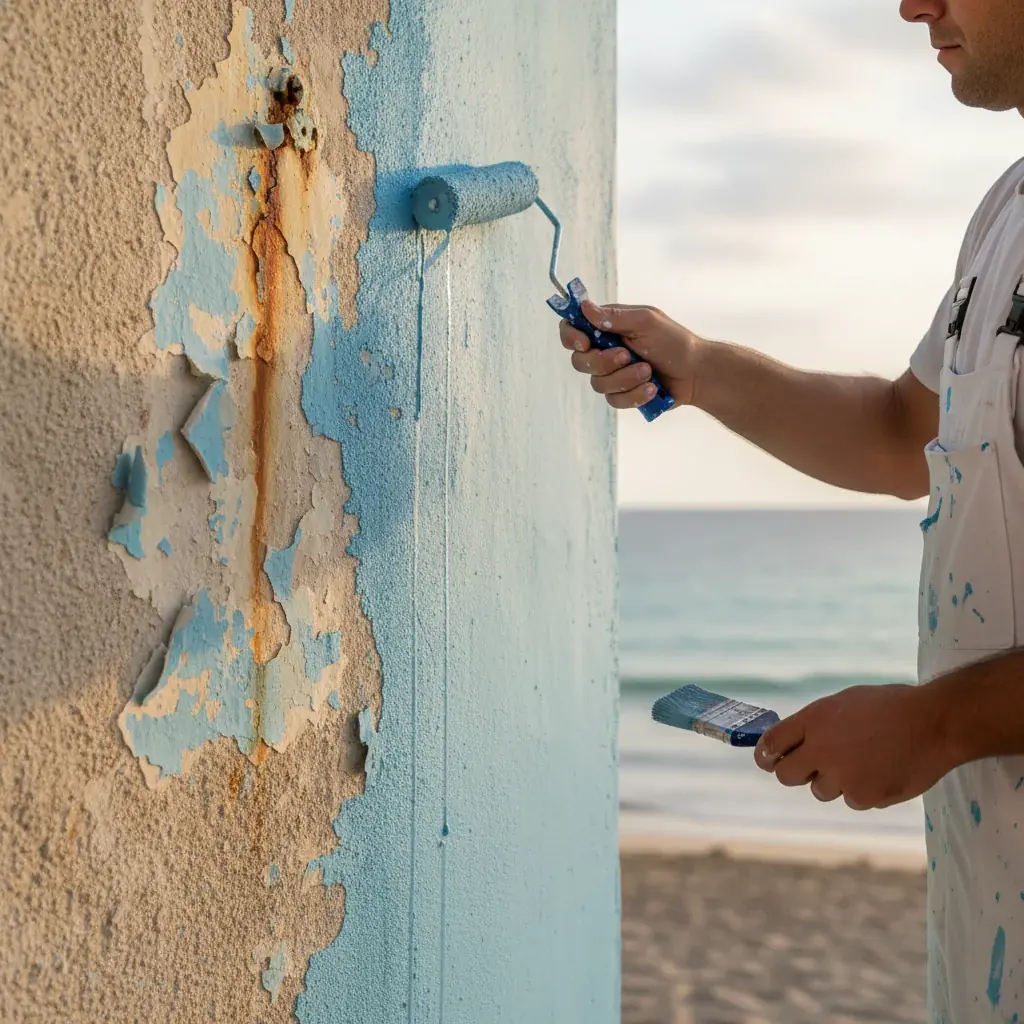
Worse yet, salt is corrosive. For homes with wood siding, it can eat away at metal fasteners like nails and screws. This corrosion can then “bleed” through the paint, creating ugly rust-colored streaks that are impossible to simply paint over. On stucco surfaces, it can attack the metal lath beneath if there are cracks, compromising the integrity of the wall itself. A standard paint job without specialized primers simply won’t stand up to this constant saline assault.
UV exposure on west-facing La Jolla walls
While salt air attacks with moisture, the sun attacks with raw energy. The intense, direct sunlight that bathes west-facing walls in neighborhoods like the Muirlands or Mount Soledad is a major cause of paint failure. Ultraviolet (UV) radiation is powerful enough to break down the molecular bonds in paint resin.
This process, called photodegradation, makes the paint film brittle and less flexible. As the surface expands and contracts with daily temperature changes, the brittle paint can no longer stretch, leading to cracking, flaking, and peeling. It also causes colors to fade dramatically. That deep, rich blue or warm terra cotta you chose can look washed out and dated in just a few seasons if you use a low-quality paint.
Darker colors are particularly vulnerable. They absorb more light and heat, which accelerates UV degradation and puts more thermal stress on the paint and the substrate underneath. For any serious exterior painting project in La Jolla, accounting for UV exposure is just as important as accounting for salt. It dictates not only the quality of paint you must use but also the long-term viability of your color choices.
Paint products that hold up: Evershield, Emerald, Resilience
You can’t fight coastal conditions with big-box store paint. Professional painters rely on specific product lines engineered for durability, adhesion, and resistance to moisture and UV rays. Here are three top-tier choices we use for La Jolla homes.
Dunn-Edwards Evershield
A go-to for San Diego painters, Evershield is a 100% acrylic paint known for its exceptional durability and color retention. It forms a tough, weather-resistant film that blocks UV rays and resists mildew growth. Its superior adhesion makes it a great choice for previously painted surfaces, provided they are prepped correctly. Evershield comes in a variety of sheens and provides a dependable, long-lasting finish that can handle the coastal climate.
Sherwin-Williams Emerald Exterior Acrylic Latex
Emerald is Sherwin-Williams’ top-of-the-line exterior paint, and for good reason. It offers extreme resistance to blistering, peeling, and fading. With its self-priming properties on properly prepared surfaces, it creates a thicker, more protective film than lower-grade paints. Emerald also contains advanced anti-microbial agents to prevent mildew from taking hold in the damp marine layer. It’s a premium product with a price to match, but the long-term performance often justifies the investment.
Sherwin-Williams Resilience Exterior Acrylic Latex
Resilience has a unique advantage for coastal painting: it’s formulated with MoistureGuard™ Technology. This allows it to withstand rain and dew much sooner after application than conventional paints, sometimes in as little as one hour. This is a huge benefit in La Jolla, where the marine layer can roll in unexpectedly. It gives us a wider application window to get the job done right without worrying about moisture compromising the cure.
For Stucco: Elastomeric Coatings
For homes with stucco, especially older ones with a web of hairline cracks, an elastomeric coating is often the best solution. These coatings are incredibly thick, about 10 times thicker than standard paint. They are waterproof and remain highly flexible, allowing them to bridge existing cracks and stretch to cover new ones that may form. This creates a durable, waterproof membrane that protects the stucco from water intrusion, a critical feature for coastal homes. Proper stucco painting with an elastomeric product is one of the best ways to protect your home’s structure.
Prep steps coastal homes can’t skip
In La Jolla, the preparation phase is more important than the painting itself. A high-end paint like Emerald applied to a dirty, salt-crusted surface will fail just as quickly as a cheap one. There are no shortcuts.
- Thorough Pressure Washing: This isn’t just about removing dirt and cobwebs. The primary goal is to remove all accumulated salt residue and chalky paint. We use a detergent solution and the appropriate pressure to deep-clean the surface without damaging it. This single step is crucial for ensuring the new primer and paint can achieve a solid bond.
- Scraping and Sanding: Any paint that is currently peeling, bubbling, or flaking must be manually scraped off. After scraping, the edges between the bare area and the sound paint are sanded to create a smooth, seamless transition. This prevents the old paint edges from showing through the new coat.
- Repair and Patching: This is where we address the underlying issues. We patch cracks in stucco, fill holes in wood siding, and replace any wood that shows signs of rot. We also check and replace failing caulk around windows, doors, and trim. Sealing these gaps is vital to prevent wind-driven rain and moisture from getting behind the siding.
- Spot-Priming and Sealing: Priming is non-negotiable. Any bare wood or metal must be spot-primed with a high-quality, corrosion-resistant primer to prevent rust bleed-through. For chalky surfaces, we apply a special sealer-binder that penetrates the chalky layer and glues it down, creating a stable surface for the topcoat to adhere to. Skipping this step is a guarantee of premature peeling.
Repaint cycles: 5 years vs 10 years
We often get asked how long a paint job should last in La Jolla. The answer depends entirely on the quality of the prep and the materials used. You are essentially choosing between two very different outcomes.
A “5-year” paint job is the result of cutting corners. It typically involves a quick, low-pressure rinse, minimal scraping, no primer, and one coat of a low-grade “contractor” paint. It might look decent for the first 12-18 months, but the coastal elements will quickly expose its weaknesses. Peeling will start around windows, chalking will accelerate, and colors will fade. You’ll find yourself back on the phone with painters in just a few years.
A “10-year” (or longer) paint job is an investment in your home’s protection. It follows all the critical prep steps listed above: a thorough power wash, extensive scraping and sanding, all necessary repairs, and the correct application of high-quality primers. This is followed by two full coats of a premium paint like Dunn-Edwards Evershield or Sherwin-Williams Emerald. The upfront cost is higher because it requires more labor and better materials. However, the cost per year of service life is significantly lower, and your home remains protected from moisture damage for far longer.
HOA color rules common in La Jolla
Many of La Jolla’s most desirable communities, from La Jolla Alta to the Muirlands and planned developments, are governed by a Homeowners Association (HOA). These HOAs have specific architectural guidelines that include pre-approved color palettes for home exteriors. Their goal is to maintain a consistent and harmonious aesthetic throughout the neighborhood.
This means you can’t just pick a color you like and start painting. The process almost always requires submitting your chosen color scheme to the HOA’s architectural review committee for approval before any work begins. This usually involves providing physical paint swatches of the body, trim, and accent colors.
Failing to get prior approval can result in fines and being forced to repaint the entire house at your own expense. As a professional company that frequently works in the area, we have extensive experience with this process. We can help you select colors from your HOA’s approved list and manage the submission process for you. Navigating the requirements is a key part of our HOA painting services. If you’re unsure about the process, it’s wise to learn more about how to get HOA exterior paint approval in San Diego to avoid any costly mistakes.
When to call us
The unique challenges of a La Jolla exterior, the salt, the sun, the stucco repairs, and the HOA rules, make it a project best left to experienced professionals. If you’re seeing signs of chalking, peeling, or cracking, it’s time to protect your home.
Call us at (858) 925-5546 for a same-day estimate.