If you searched “residential painting” and you manage an HOA, a portfolio of rentals, a new condo build, or a multi-unit property, you’re not looking for the same thing a single-family homeowner is looking for. You need scope language that survives board review, pricing that scales across units, and a contractor who’s signed COIs and lien releases before. This guide is for that audience. Property managers, HOA board members, residential developers, and multi-unit owners working across San Diego County.
The short version: residential painting covers community-wide repaints, single-elevation refreshes, common-area painting, exterior-only HOA programs, post-construction final paint for new builds, and turnover paint for rentals. Pricing usually runs per unit, per elevation, or per square foot depending on the project shape. Call us at (858) 925-5546 for a free residential painting estimate anywhere in San Diego County.
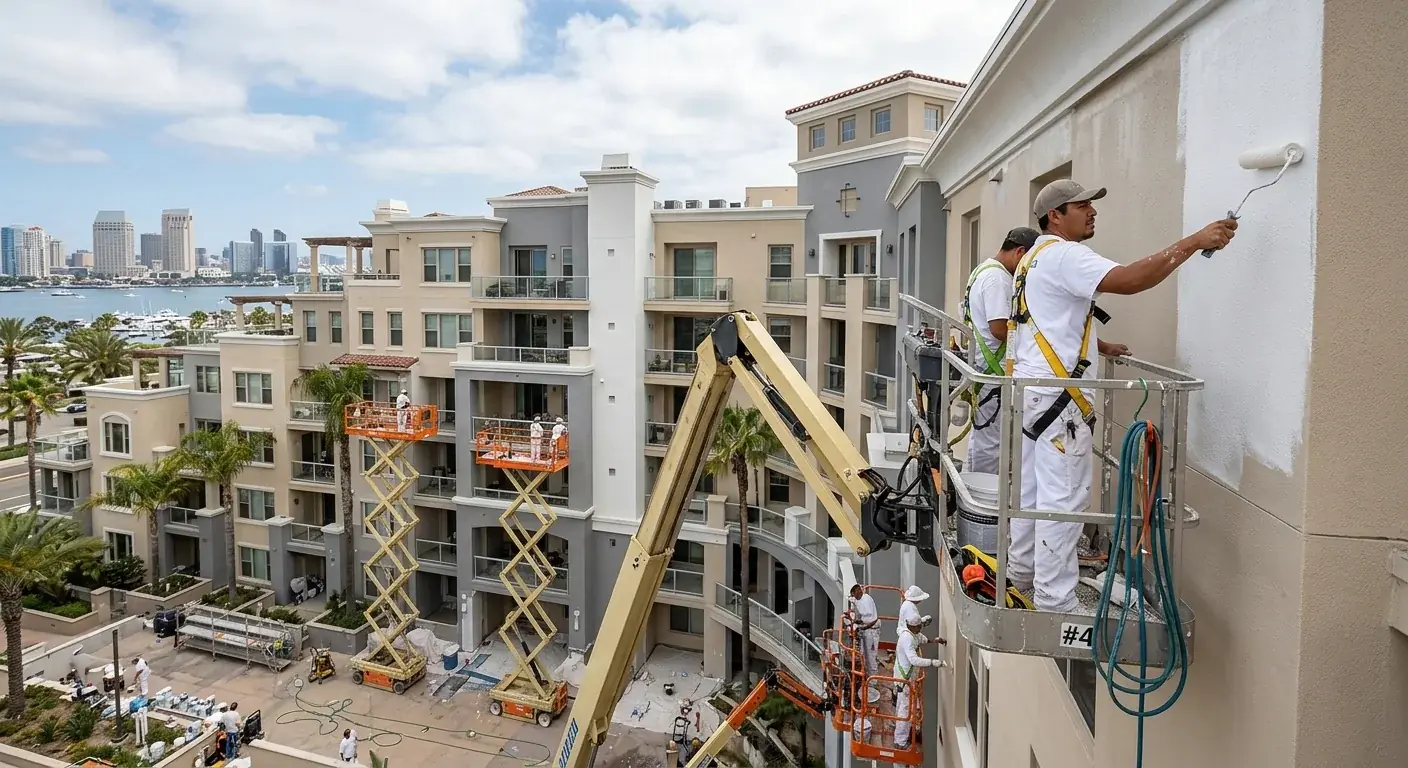
What residential painting includes
“Residential painting” is a broader category than “house painting,” even though search engines sometimes lump them together. When property managers and HOA boards use the phrase, they usually mean one of six project types.
Community-wide repaints. Every unit and elevation across an HOA or condo association painted in one coordinated project. Typically tied to a reserve study’s 7-to-10-year paint cycle. The largest line item most associations face outside of roof and asphalt.
Single-elevation refreshes. Repainting one face of a building (commonly the south or west elevation, where UV degrades coating fastest) without touching the rest of the property. Useful when the reserve study calls for staggered cycles instead of a full hit.
Common-area painting. Clubhouses, leasing offices, hallways, stairwells, mailroom enclosures, pool-deck fences, gate housings. High-traffic surfaces that need durable, washable finishes rather than the standard exterior-grade product used on building shells.
Exterior-only HOA programs. Some associations contract exterior repaints across the community while leaving unit interiors to individual homeowners. This is the most common HOA paint program in San Diego.
Post-construction final paint for new builds. The last paint pass on a new residential development before certificates of occupancy issue. Tight scheduling around drywall, trim, and punch list. Often coordinated directly with the general contractor’s superintendent rather than an owner or board.
Property-management turnover paint. Rapid repaints between tenants on individual units. Usually one-day or two-day turnarounds, standard color, prep level matched to lease cycle.
Each of these has a different pricing model, scope sheet, and risk profile. Lumping them together is what gets associations into trouble.
How residential painting differs from house painting
A single-family house paint job is one decision-maker, one schedule, one set of keys, one driveway to stage from. Residential painting at the multi-unit level is a different animal. Five differences matter most.
Phased schedule. A 30-unit HOA repaint runs in phases, typically by building or by elevation, so residents aren’t displaced and parking isn’t blocked all at once. Phasing also lets a contractor stage materials closer to the active work area, which cuts crew transit time and lowers cost. Expect a working schedule across two to six weeks for a mid-size community, longer for projects above 100 units.
Master color spec compliance. Every HOA has an approved color palette, often locked in CC&Rs (Covenants, Conditions, and Restrictions). A residential painting contractor needs to match approved samples exactly, including the LRV (Light Reflectance Value) when boards have specified one. Variations between batches are tracked and documented.
Board approval process. Most HOA boards require multiple bids, a formal board vote, and sometimes a community-wide announcement before the project starts. The contractor’s bid package needs to support that process. Itemized scope, named materials with spec sheets, references on similar-size projects, COI on file, and a project timeline with milestones the board can vote on as a single package.
Insurance certificates for managers. Property managers and HOA boards need a Certificate of Insurance (COI) listing the association as an additional insured before a brush touches a wall. General liability typically at $2M per occurrence and $4M aggregate is the floor for any multi-unit project. Workers comp is non-negotiable. The Contractors State License Board (cslb.ca.gov) is where managers should verify the contractor’s license status before signing.
Lien-release tracking. California’s mechanic’s-lien laws mean a residential developer or HOA can be exposed if a subcontractor or supplier isn’t paid by the prime contractor. Unconditional lien releases (Civil Code section 8132 / 8134) at progress payments and at completion are how property managers protect the association. A residential painting contractor should be proactive about supplying them.
HOA-community repaint planning
A community-wide repaint isn’t a project you start in the same fiscal year you decide to do it. The planning runway is usually 9 to 18 months.
Most San Diego associations sit on a 7-to-10-year paint cycle. Coastal communities in Pacific Beach, Ocean Beach, Imperial Beach, La Jolla, Coronado, and Del Mar push toward the shorter end because of salt-air corrosion and UV. Inland communities in Poway, Escondido, El Cajon, and Santee can stretch toward 10 years if the original coating was elastomeric and the prep was clean.
The planning sequence we see work consistently looks like this.
First, the reserve study. The association’s reserve specialist projects the paint cycle and funds the reserve accordingly. If the reserve is underfunded, the board is choosing between a special assessment, a loan, or a phased project across two budget years.
Second, the bid package. Three contractor bids is standard. Five is better. The board chair, property manager, and architectural committee should agree on scope language before bids go out, otherwise the bids aren’t comparable.
Third, the sample-board process. The board picks three to five color schemes that fit the existing palette and CC&Rs. Test sections (usually 4-by-8-foot panels) get painted on at least two buildings to evaluate how each color reads at morning, midday, and afternoon light. San Diego’s coastal light shifts colors more than inland buyers expect.
Fourth, the phased schedule. With contractor selected and colors approved, the project breaks into building-by-building or elevation-by-elevation phases. Phasing lets residents stay in place, keeps parking and access workable, and lets the painting crew move predictably.
Fifth, the announcement and resident communication. Residents need 30 days’ notice minimum, with reminders at 14 days, 7 days, and 24 hours before crews arrive at their building. The contractor and property manager share that workload.
Multi-unit pricing models
How a residential painting bid is priced says as much about the contractor as the dollar amount. Three models dominate.
Per unit. Common on apartment turnover programs and on some HOA bids where every unit is roughly identical. Simple to budget against. Risk: doesn’t capture the variation between a corner unit (more exterior wall) and an interior unit. Bidders favor this when units are uniform; managers favor it when they want a flat per-door number.
Per elevation. Common on garden-style apartments, townhome rows, and condo buildings where building shells repeat. Each elevation gets a line item. This is the model most experienced HOA contractors prefer because it tracks the actual paintable surface more honestly than per-unit. Risk: requires accurate take-offs, so a sloppy estimator can leave money on the table or surprise the board with change orders.
Per square foot. Common on irregular properties, mixed-use buildings, and projects with significant common-area painting alongside building shells. The most defensible model for unusual scopes, but it requires the most documentation and a clear scope sheet that defines what counts as a “square foot of paintable surface.”
Scope-creep risks to watch on any model: undisclosed substrate repair (stucco cracks, dry rot, hairline fractures), unmarked color changes (boards adding accent colors after bid), and access surcharges (lifts, scaffolding, or roof tie-offs that weren’t in the original bid). The mitigation is the same in every case. The scope sheet, the materials spec, and the unit count get fixed at bid award. Change orders go through the property manager in writing.
A working budget range for San Diego County residential exteriors in 2026: roughly $1,800 to $3,200 per unit for a stucco condo community on a standard repaint, depending on substrate condition, color count, and access. Mid-rise buildings with lifts run higher. Our exterior painting cost in San Diego guide breaks down the per-square-foot math behind those numbers.
San Diego-specific residential painting considerations
San Diego isn’t one paint climate. It’s five.
Coastal salt-air corrosion at PB, OB, IB, La Jolla, Coronado, Del Mar, Mission Beach. Any HOA within a mile of the coast deals with salt-air degradation. Elastomeric coatings outperform standard acrylic exteriors on stucco shells in those zones, and prep needs to include power-wash plus salt-residue rinse. Coatings that work fine in Escondido fail in Pacific Beach.
Marine layer and June Gloom scheduling. Coastal communities lose morning hours to marine layer roughly half of June and July. Building dry time into the phased schedule keeps crews from spraying onto damp substrates. Inland projects don’t have this problem.
Fire-safety code in east county HOAs. Communities in Alpine, Jamul, Ramona, Lakeside, Valley Center, and parts of Poway sit in California’s Wildland-Urban Interface zones. Wildfire-safety regulations affect material choice. Some associations require WUI-compliant exterior coatings on certain elevations. Worth confirming with the local fire-protection district before specifying paint.
Water-intrusion repair before paint. Stucco cracks wider than a credit card or efflorescence stains on building corners signal moisture migration that paint won’t fix. The right sequence is leak source diagnosis, repair, dry-out, then paint. Skipping it traps moisture and shortens the new coating’s life by years. We cover this in common stucco problems in San Diego.
Microclimates inside one community. A 60-unit condo in Carlsbad can have one building facing direct coastal exposure and another tucked behind a windbreak. The shaded building may not need elastomeric. The exposed building does. A good residential painting estimator walks the property and writes the spec building by building, not as a single homogeneous number.
Choosing a residential painting contractor in San Diego
Property managers asking the right questions filter out the bottom 70 percent of bidders in 15 minutes. Five things to verify.
Licensing through the CSLB. California requires a C-33 Painting and Decorating license for any project above $500. Run the license number on cslb.ca.gov and check status, classification, bond, and workers comp. Anything pending, suspended, or missing is a hard pass.
Multi-million-dollar insurance. General liability $2M per occurrence and $4M aggregate is the working floor. Higher on larger or mid-rise projects. Ask for a current COI listing the association or property owner as an additional insured. Verify it’s current, not lapsed.
Multi-day weather contingency. What’s the contractor’s plan when marine layer holds three mornings in a row? Or when a Santa Ana wind event blows dust through fresh paint? Experienced contractors have written contingency clauses and float days built into the schedule. Inexperienced ones don’t, and that’s where projects slip.
References on similar-size projects. Two HOA references at minimum, at the same unit count or larger, on projects completed within the last three years. Call them. Ask about communication, schedule adherence, change orders, and what they’d do differently. The Community Associations Institute (caionline.org) is also a useful place to vet trade contractors that engage with the industry.
Certificate-of-completion process. When the project finishes, the contractor should hand the property manager a closeout package: final unconditional lien release, warranty document, color and product spec sheets for future touch-ups, photo documentation of completed work, and the certificate of completion itself. Managers who’ve done this before know that closeout package matters more than the bid price.
You can also check the Better Business Bureau (bbb.org) for complaint history, and review the contractor’s standing with Sherwin-Williams’ PRO Services (sherwin-williams.com/painting-contractors) or Behr’s Pro Rewards (behrpro.com) property-management programs, which qualify contractors based on volume and quality.
Sample residential project types
To make the categories concrete, here are four typical San Diego County residential painting scopes we bid.
Project A: HOA exterior repaint, 30-unit condo complex in Mira Mesa. Six buildings, two-story stucco with wood trim. Per-elevation pricing. Three-color scheme matching CC&Rs. Phased over three weeks, one building per phase. Elastomeric on south and west elevations.
Project B: Condo common-area refresh, mid-rise downtown. Interior corridors on 12 floors, mail room, lobby. Two-color scheme with accent wall. After-hours scheduling. Washable eggshell finish. Five-night working window across two weeks.
Project C: Post-construction final paint, 24-unit townhome development in Otay Ranch. Working from the general contractor’s punch list. Interior and exterior, every unit. Five-week window from drywall sign-off to certificate-of-occupancy walk.
Project D: Property-management turnover paint, 8-unit rental in North Park. Single-day turn between tenants. Standard property-manager color throughout. Light prep, two coats, full clean before key handoff.
Each scope has its own pricing model, crew size, and timeline. Manage them as four different things, because they are.
When to call us
If you’re planning a community-wide repaint, vetting bids for a board meeting, scheduling turnover paint across a rental portfolio, or coordinating final paint on a new build, give us a call. We’ll walk the property, write the spec building by building, and put a phased schedule on paper your board or property manager can vote on. Call us at (858) 925-5546 for a free San Diego residential painting estimate. You can also read our companion guides on HOA exterior paint approval, HOA paint color rules, hiring HOA painting contractors, and commercial painting in San Diego to prep for the bid process. For substrate-specific reading, our stucco painting in San Diego breakdown covers material choice on coastal exteriors. Our interior painting and exterior painting service pages cover the full residential scope.
Residential painting in San Diego: FAQs
How do you handle multi-unit scheduling? We build a phased schedule by building or by elevation depending on the property shape. Residents stay in place. Each phase has a defined start, finish, and a 24-hour heads-up the night before crews arrive at their unit. Property managers get a daily progress note. Most 30-to-60-unit communities finish in two to four weeks.
Can you provide insurance certificates for property managers? Yes. We carry general liability at $2M per occurrence and $4M aggregate, plus workers comp on every employee. We list the association or property owner as an additional insured on the COI and supply it before the project starts. Lien releases come at each progress payment and at project close.
Do you do HOA color-board work? Yes. We help boards build sample boards, paint 4-by-8 test panels on actual buildings, and present color and product specs in the format architectural committees and boards review. If the CC&Rs lock the palette, we match exactly. If the board is open to refresh, we propose options that fit the community’s existing character.
What’s typical per-unit cost on a San Diego HOA exterior? Rough working range for 2026 is $1,800 to $3,200 per unit for a standard stucco condo community, depending on substrate condition, color count, building height, and access. Mid-rise or lift-dependent projects run higher. Coastal projects with elastomeric specs run higher. The board gets a fixed per-unit or per-elevation number after the walk-through, not a range.
Can you work around tenants and residents? Yes. Phased scheduling, posted notices, and a single on-site project manager who’s the point of contact for residents is how multi-unit work runs. Common-area access stays open. Parking accommodations get arranged with the property manager in advance. We don’t enter occupied units on exterior-only HOA programs unless a balcony or patio is in scope and the resident has been notified.
How soon can you start? Standard lead time for a community-wide HOA repaint is six to ten weeks from contract signing to first day on site, driven mostly by reserve-funded board approval cycles and color-board reviews. Turnover paint can start within a week. Post-construction final paint is scheduled directly with the general contractor’s project schedule. Faster starts are usually possible on rentals and turnover work.
What is residential painting? Residential painting covers any habitable property: single-family homes, condos, townhomes, apartments, HOA-managed communities, and small multifamily buildings up to roughly 50 units. It includes interior wall and ceiling work, exterior stucco and siding, cabinet refinishing, trim and door work, and HOA common-area painting. The distinction from commercial painting is property type, not scope. Commercial work covers offices, retail, industrial, restaurants, and large multifamily over 50 units.
How much does residential painting cost? Interior repaints run $4,500 to $14,000 in San Diego. Exterior stucco repaints run $7,500 to $20,000. Cabinet refinishing runs $3,500 to $13,000. HOA per-unit pricing runs $1,800 to $3,200 on stucco condo communities. Coastal jobs add 10 to 20 percent. Two-story homes add 25 to 40 percent over single-story on the same footprint.
What is included in residential painting? Standard scope includes surface prep (clean, scrape, sand, patch), primer where needed, two coats of paint on every surface, masking and protection of fixtures and flooring, daily cleanup, and a written warranty (usually 2 to 5 years on labor). Premium scope adds caulking by linear foot, full pressure wash on exteriors, color consultation, hardware removal and reinstall, and longer warranty terms (5 to 7 years).
How long does residential painting take? Single-room interior: 1 to 3 days. Full-interior 3-bedroom home: 5 to 7 working days. Single-story exterior stucco: 4 to 7 days. Two-story exterior: 7 to 14 days. Cabinet refinishing: 5 to 10 days. HOA community-wide repaints: 2 to 4 weeks for a 30-to-60-unit property. Multi-property portfolios: scheduled in phases over 1 to 3 months depending on portfolio size.
Do I need a permit to paint my house in San Diego? No, painting does not require a building permit in San Diego County. The contractor needs a current C-33 painting license from the California Contractors State License Board for any job over $500, but the homeowner doesn’t pull a permit for paint work. HOA communities require architectural review committee approval for any color change, which is a private-association process, not a public permit.
What is the best paint for a residential home in San Diego? For interiors, Sherwin-Williams Emerald, Benjamin Moore Regal Select, or Dunn-Edwards Suprema are the standard premium picks. For exteriors on stucco, Sherwin-Williams Loxon XP, Benjamin Moore Aura Exterior, or Dunn-Edwards Evershield. For cabinets, Benjamin Moore Advance or Sherwin-Williams Emerald Urethane Trim Enamel. Coastal homes benefit from premium paint more than inland homes because cheap exterior paint fails fast in salt air.
Call us at (858) 925-5546 for a free San Diego residential painting estimate.