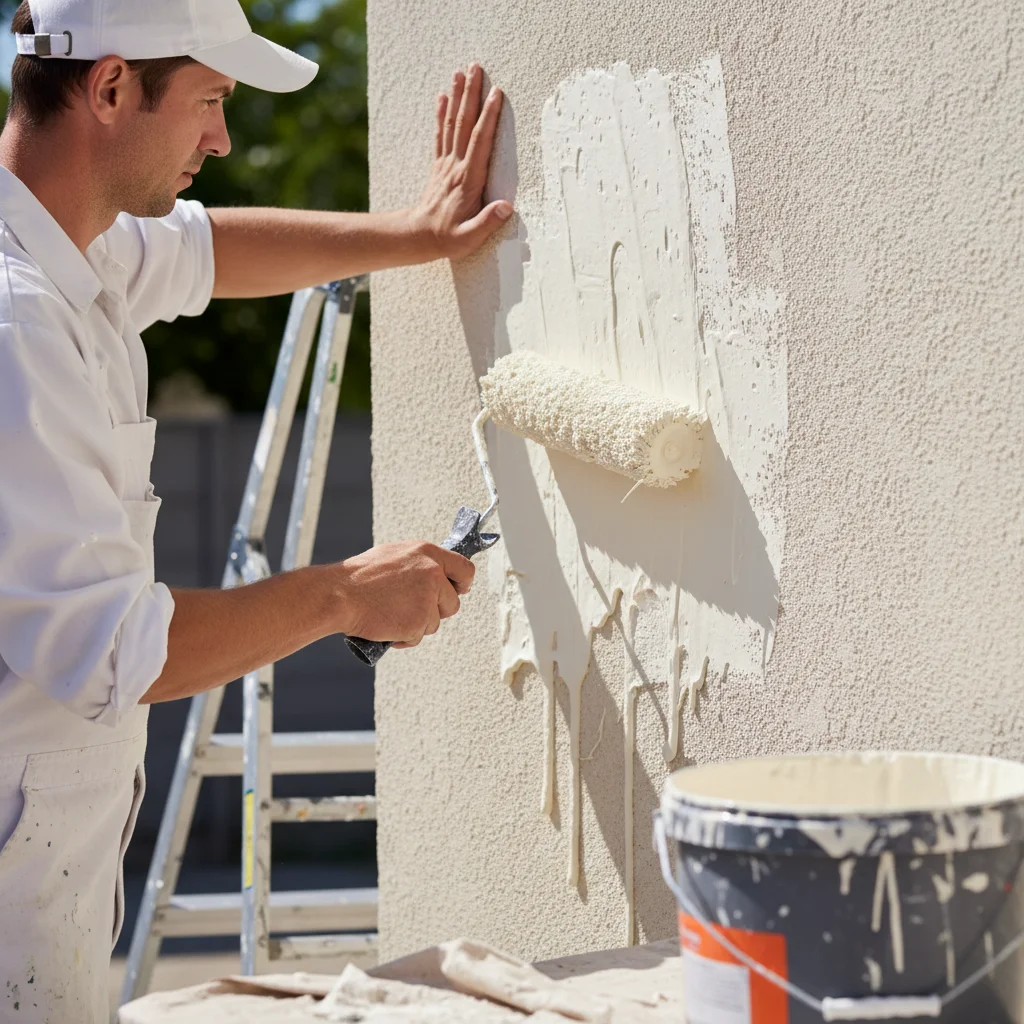
Written by The Paint Pros San Diego Team. We paint roughly 180 exteriors a year across San Diego County, the vast majority of them stucco. We pull elastomeric and siliconized acrylic off the shelf every week, on contractor accounts at Sherwin-Williams, Dunn-Edwards, and Benjamin Moore, and we watch how each one holds up on coastal Coronado, inland Escondido, and everywhere between. This is the comparison we actually use when we walk a property.
Elastomeric bridges hairline cracks but traps moisture. Siliconized acrylic breathes better, lasts longer on stable stucco, and applies like a normal exterior coat. For most San Diego homes, choose siliconized acrylic. Reserve elastomeric for stucco that’s visibly cracking, where the crack-bridging is doing real work that breathability can’t. Free estimates at (858) 925-5546.
Quick verdict
If your stucco is sound, with no active hairline cracking, buy siliconized acrylic. Sherwin-Williams Loxon XP, Dunn-Edwards Evershield, or Benjamin Moore Aura Exterior all qualify. You’ll get 12 to 15 years of life, real vapor permeability, and a normal coat thickness.
If your stucco has visible hairline cracks across multiple elevations and you’re not ready to re-stucco, buy elastomeric. Sherwin-Williams ConFlex, Behr Premium Plus Elastomeric, or Dunn-Edwards Eviton will bridge those cracks for 10 to 12 years. You’ll pay more, you’ll need a more careful application, and you’ll trade some breathability for that crack protection.
For the broader elastomeric-vs-regular-acrylic question, see our elastomeric vs acrylic paint for San Diego stucco walls guide. This one zooms in on the more nuanced choice: elastomeric versus the silicone-modified acrylics that have largely replaced standard acrylic on premium exterior jobs.
What “elastomeric” actually means
Elastomeric coatings are high-build acrylic films engineered to stretch 200 to 400 percent and return to shape without tearing. ASTM C1305 is the standard test for that flexibility; reputable elastomerics pass it. The material is loaded with solids, so a single coat lays down at 10 to 20 dry mils, roughly 6 to 10 times the thickness of a normal exterior coat. That thickness is the point. It builds a continuous rubbery membrane across the stucco face that bridges hairline cracks up to about 1/16 inch wide, even as the wall flexes through daily thermal cycles.
The catch is moisture. Elastomerics have low vapor permeance, often 5 to 15 perms or less. Stucco assemblies in San Diego often carry residual moisture from the original three-coat installation, from past leaks at windows and roof intersections, or from marine-layer condensation on north-facing walls. Seal that moisture in with a low-perm membrane and you get blistering, delamination, or efflorescence pushing the coating off the wall in sheets within two to four years. We’ve stripped elastomeric off Escondido and Carmel Valley walls that failed exactly this way.
Elastomeric also doesn’t apply like normal paint. It needs the right primer for the substrate, a heavy nap roller or airless sprayer rated for high viscosity, and back-rolling to push the material into the stucco texture. Skimping on any of that produces pinholes, lap marks, or a coat that looks fine on day one and peels on month eighteen.
What “siliconized” means
Siliconized acrylic, sometimes called silicone-modified acrylic or siloxane-modified acrylic, blends silicone polymers into a 100 percent acrylic resin base. The silicone fraction sits at the surface and makes the cured film hydrophobic. Water beads and runs off; rain doesn’t soak in; dirt and mildew have less to hold onto.
The key word is hydrophobic, not impermeable. The film still lets water vapor pass from inside the wall out, typically 10 to 30 perms depending on the product. That’s the right direction for San Diego stucco, which needs to dry inward and outward as the day cycles between cool damp mornings and hot dry afternoons. ASTM E96 is the vapor permeance test; the data sheets for Loxon XP, Evershield, and Aura Exterior all publish numbers in the breathable range.
Siliconized acrylics apply at normal mil thickness, usually 3 to 5 dry mils per coat, two coats total. No special sprayer. No back-rolling crusade. The crew handles it like any other premium exterior. The film won’t bridge a crack wider than the paint itself, which is the honest limit of the category. If your stucco moves, this coating cracks with it.
The breathability factor
This is the single most important variable for a San Diego stucco repaint, and it’s the one most contractors gloss over. Stucco is a cementitious wall surface bonded to a weather-resistant barrier and framing behind it. Moisture gets in through cracks, around windows, behind flashing, from interior humidity, and from marine layer condensation. The wall assembly’s only escape route for that moisture is outward, through the stucco and through whatever paint sits on top.
Coat the wall in a low-perm elastomeric and you cap that escape route. Trapped moisture pushes the coating off the substrate. Blisters, peeling, sometimes a chalky bloom of efflorescence where calcium hydroxide migrates to the surface and crystallizes. We see this most often on shaded north and east elevations in coastal zones, the same walls that carry the highest marine-layer moisture load.
Siliconized acrylic lets vapor pass while still shedding bulk water. You get the rain-and-irrigation protection without the moisture trap. For 80 to 90 percent of San Diego homes, that’s the right tradeoff. The only stucco that genuinely needs the low-perm seal is stucco that’s already cracked enough that bulk water intrusion outweighs the trapped-vapor risk.
Crack-bridging capability
Elastomeric wins here, and it’s the only place it wins decisively.
A cured elastomeric film at 15 dry mils will stretch across a 1/16 inch hairline crack and stay intact through years of thermal expansion. Siliconized acrylic at 4 dry mils won’t. If you spot-patch the crack first with elastomeric patching compound and then topcoat with siliconized acrylic, you can sometimes salvage the situation, but the long-term play on a heavily cracking wall is still elastomeric over the whole field.
Honest caveat: elastomeric doesn’t bridge structural cracks, settlement cracks, or anything wider than about 1/16 inch. Those need stucco patching first, sometimes a fiberglass mesh and base-coat repair. We cover that workflow in our stucco crack repair before painting guide. Painting over a wide crack with any product, including elastomeric, telegraphs the crack back through within a season.
Side-by-side comparison
| Factor | Elastomeric | Siliconized acrylic |
|---|---|---|
| Crack-bridging | Up to 1/16 inch hairlines | None beyond the paint film |
| Vapor permeance (ASTM E96) | 5 to 15 perms (low) | 10 to 30 perms (breathable) |
| Dry mil thickness per coat | 10 to 20 mils | 3 to 5 mils |
| Expected lifespan in San Diego | 10 to 12 years | 12 to 15 years on stable stucco |
| Material cost per gallon | $55 to $85 | $65 to $108 |
| Material cost per square foot | Higher (lower spread rate) | Standard |
| Application difficulty | High (sprayer, back-roll, prime) | Standard (any exterior crew) |
| Recoatability | Only with another elastomeric or compatible primer | Recoat with any quality acrylic |
| Best for | Visibly cracking stucco | Sound stucco, coastal, HOA, newer construction |
The San Diego decision framework
This is how we actually decide on a walk-through.
Pick elastomeric when:
- The stucco shows visible hairline cracking across multiple elevations, not just one corner
- The home was built between roughly 1980 and 2005, the era of high-volume stucco with thin base coats that crack as they age
- There’s active wall movement, often visible as cracks that reopen after patching
- The owner isn’t ready for the cost of re-stuccoing and wants a 10-year coating that buys time
- Past paint jobs cracked along the same lines within three to five years
Pick siliconized acrylic when:
- The stucco is sound, with no widespread hairline cracking
- The home is coastal (Coronado, La Jolla, Encinitas, Carlsbad, Imperial Beach) where marine-layer humidity makes trapped moisture more dangerous than crack-bridging
- The home is in an HOA that’s repainting on a 10-year cycle and the spec calls for premium acrylic
- The home is newer construction, post-2010, with modern stucco assemblies that don’t show the same crack patterns
- You want the longest color life and the best dirt-shedding for high-visibility elevations
Mixed approach (we do this often): Elastomeric on the one or two cracked elevations, siliconized acrylic on the rest. This is legitimate, costs less than full elastomeric, and gives each wall what it actually needs. The color match between brands is easier than people think; both categories tint from the same colorant systems.
Real San Diego product picks
These are the products we buy on local accounts. Prices are 2026 retail in San Diego stores, before contractor discounts.
Elastomeric:
- Sherwin-Williams ConFlex Smooth Acrylic Elastomeric. Around $60 to $75 per gallon. The workhorse. Spreads better than most elastomerics, two-coat application, recoatable in 4 hours. Spec sheet at sherwin-williams.com/painting-contractors/products/conflex-smooth-acrylic-elastomeric-high-build-coating.
- Dunn-Edwards Eviton 100 percent Acrylic Elastomeric. Around $65 to $80 per gallon. Strong local availability across San Diego County, formulated for Southwest stucco, holds color well. Spec at dunnedwards.com/pros/products/eviton-elastomeric-flat.
- Behr Premium Plus Elastomeric Masonry. Around $55 to $65 per gallon at Home Depot. The DIY-accessible option, fine for a careful homeowner with a sprayer, less crew-friendly on a 3,000-square-foot job. Spec at behr.com/consumer/products/exterior-paint/masonry-stucco-brick-paint/behr-premium-plus-elastomeric-masonry-stucco-brick-paint.
Siliconized acrylic:
- Sherwin-Williams Loxon XP Waterproofing Masonry Coating. Around $75 to $88 per gallon. The category benchmark. Genuinely breathable, applies at 5 to 7 dry mils per coat, two coats spec’d, holds up under coastal salt air. Spec at sherwin-williams.com/painting-contractors/products/loxon-xp-waterproofing-masonry-coating.
- Dunn-Edwards Evershield High Performance Exterior. Around $78 to $92 per gallon. Silicone-modified acrylic, full breathability, our most-used premium pick on Dunn-Edwards specs. Spec at dunnedwards.com/pros/products/evershield-flat.
- Benjamin Moore Aura Exterior. Around $94 to $104 per gallon. Premium acrylic with siloxane modification, Color Lock technology, our pick when color depth and 15-year color hold matter most. Spec at benjaminmoore.com/en-us/product-catalog/products/636.
- Dunn-Edwards Aristoshield. Around $82 to $95 per gallon. Acrylic urethane hybrid, mostly an interior trim product but worth knowing if Dunn-Edwards is the spec’d brand. Spec at dunnedwards.com/pros/products/aristoshield.
For more on the brand-level differences, see our Sherwin-Williams vs Behr exterior paint for stucco and Benjamin Moore vs Sherwin-Williams exterior San Diego breakdowns.
Application differences that matter
Siliconized acrylic applies like a normal premium exterior. Pressure wash, repair any cracks, prime bare or chalky spots with a masonry primer like Loxon Conditioner or Dunn-Edwards EZ-Prime Premium, two finish coats sprayed or rolled at 3 to 5 dry mils each, recoat in 4 hours, full cure in 30 days. Any decent crew handles it.
Elastomeric is a different job. The substrate has to be dry, with moisture readings under 12 percent on a Tramex meter. The primer matters: an alkali-resistant masonry primer (Loxon Conditioner, ConFlex Acrylic Primer) is non-negotiable on fresh or chalky stucco. The finish coat goes on at 10 to 20 dry mils per coat, often two coats, almost always with an airless sprayer rated for high-viscosity coatings (Graco 695 or larger), followed by back-rolling with a 1 to 1.25 inch nap roller to push the material into the texture. Skip the back-roll and you get pinholes. Rush the recoat window and you get solvent entrapment. The dry-to-touch number on the can is not the recoat number.
A typical 2,800-square-foot San Diego stucco repaint runs one to two days in siliconized acrylic and two to three days in elastomeric, mostly because of the back-rolling and the longer dry windows.
Why most SD contractors default to elastomeric (and why that’s often wrong)
Elastomeric has been marketed hard in California since the 1980s. The pitch is intuitive: cracks bad, rubber paint good. Rep visits at paint stores push the category. The margins are higher for both manufacturer and contractor. And it’s true, elastomeric solves a real problem on a real subset of homes.
The miss is that San Diego stucco doesn’t crack the way East Coast and Midwest stucco cracks. We don’t have freeze-thaw cycles. Our temperature swings, even in inland zones, rarely cross the threshold that drives the worst hairline cracking patterns. Most San Diego stucco from 2005 onward holds together fine on a 10 to 15 year cycle. Pricing the whole house in elastomeric when only one elevation is cracking, or when no elevation is cracking, is selling the homeowner a product they don’t need and trading breathability they do need.
The Stucco Manufacturers Association publishes guidance on coating selection that lines up with this read: match the coating’s perm rating to the substrate’s moisture load. See their resource library at stuccomfgassoc.com. On most San Diego walls, that math comes out in favor of breathable siliconized acrylic.
If a bid comes in with elastomeric across the whole house and there are no visible cracks, ask the contractor to show you the cracks. If they can’t, the bid is wrong for the home.
FAQ
Which lasts longer in San Diego, elastomeric or siliconized acrylic? On sound stucco, siliconized acrylic lasts longer. 12 to 15 years versus 10 to 12 for elastomeric. The breathability is the reason. Elastomeric tends to fail at the substrate, not at the surface, once trapped moisture starts pushing it off. Siliconized acrylic ages by chalking and fading, which is gentler and easier to recoat.
Can you re-coat an elastomeric wall with siliconized acrylic later? Not directly. The flexible elastomeric base will move under the rigid siliconized coat and crack it within a season or two. If you’re switching categories, the elastomeric needs to come off, which means scraping, water-blasting, and a bonding primer. Easier to stay in the same category when recoating.
Can a homeowner DIY either of these? Siliconized acrylic, yes, with a good airless sprayer or a careful roll-and-brush job. Elastomeric, technically yes, but the application is unforgiving. The mil thickness, the back-rolling, and the primer compatibility are easy to get wrong, and a wrong elastomeric job fails worse than a wrong acrylic job. If you’re DIY-ing, go siliconized.
Which is more expensive on a full project? Elastomeric is 25 to 50 percent more on the total project, mostly from lower spread rate and longer labor. A $7,000 siliconized job runs $9,000 to $10,500 in elastomeric, all else equal.
Can you mix products, elastomeric on some walls and siliconized on others? Yes, and we recommend it on cracked-on-some-walls-only situations. Color match is straightforward because both categories tint from the same colorant systems. Use the same brand across both products if you can, to keep the colorant batch identical.
Do you give free estimates? Yes. Free San Diego stucco-paint consultations across all 47 cities we serve. We’ll walk the property, read moisture, identify cracks, and give you an honest pick between elastomeric, siliconized acrylic, or a mixed approach. Book at (858) 925-5546.
When to call us
The elastomeric versus siliconized acrylic call is a moisture and crack-pattern call, not a marketing call. We’ve stripped enough failed elastomeric off San Diego walls to take the question seriously. If your stucco is sound, you want breathability. If your stucco is cracking, you want crack-bridging. Most homes need one or the other, sometimes both on different walls, and the wrong choice costs five figures in premature failure.
For the full stucco repaint workflow, including prep, see our stucco painting guide for San Diego, our how often to repaint stucco in San Diego explainer, our stucco crack repair before painting breakdown, and the stucco painting service page.
Call (858) 925-5546 for a free San Diego stucco-paint consultation. We’ll tell you which category your walls actually need, and why.