Stucco painting in San Diego runs $3,500 to $12,000 for most single-family homes, with the bulk of jobs landing between $5,500 and $8,500. It’s not the same as regular exterior painting. Stucco is porous, cracks differently than wood or fiber cement, and has to breathe. The right job is pressure wash, crack repair, primer, and two finish coats with a paint chemistry matched to your micro-climate (coastal salt air, marine layer, or inland heat). Skip any of those and the coating fails in 3 to 5 years instead of lasting 10 to 15.
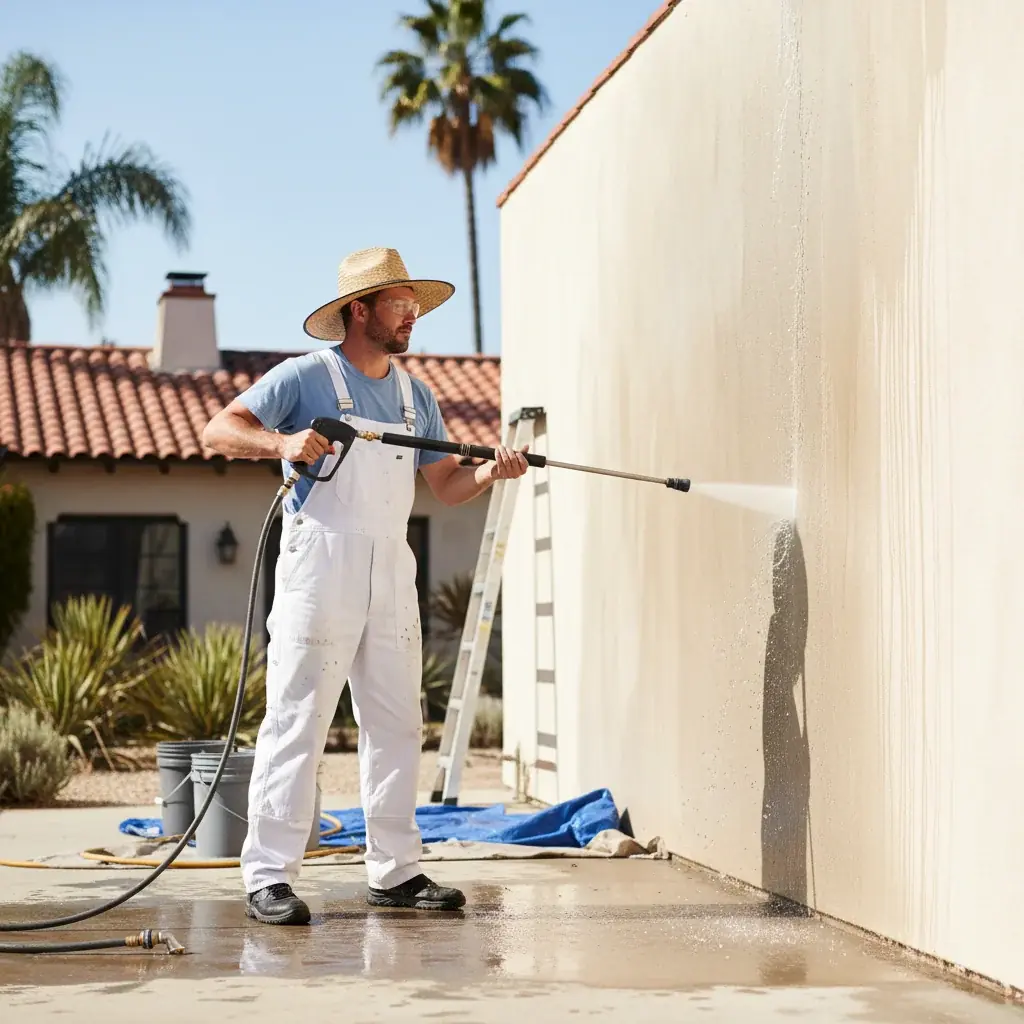
What “stucco painting” actually includes in San Diego
When you book a real stucco painting job in SD County, you’re paying for six steps, not one. Every step matters. The shortcut crews skip three of them and the coating fails fast.
Step 1: Pressure wash. Stucco holds onto dust, soot, pollen, marine-layer mildew, and (at the coast) salt deposits. Paint won’t bond to any of that. A proper wash uses 1,500 to 2,500 PSI with a 25 or 40 degree tip and a soft surface cleaner. Coastal homes (Pacific Beach, Ocean Beach, Imperial Beach, Coronado, La Jolla, Solana Beach, Encinitas, Carlsbad, Oceanside) typically need a mildewcide added because the marine layer feeds black-and-green growth in the texture pockets. See our pressure washing before painting guide for the full process.
Step 2: Crack repair. Every SD stucco home has hairline cracks. Most are cosmetic (under 1/16 inch) and just need an elastomeric patch compound or a paintable acrylic caulk worked into the crack with a putty knife. Wider cracks (1/16 to 1/4 inch) need a sanded patch compound feathered into the texture. Anything over 1/4 inch usually means structural movement, water intrusion, or settling, and a stucco repair contractor needs to look at it before painting. Our stucco crack repair before painting walkthrough covers the decision tree.
Step 3: Primer. This is the step most cheap quotes skip. A masonry conditioner like Loxon Concrete & Masonry Primer (Sherwin-Williams) or Behr Premium Plus Masonry, Stucco & Brick Bonding Primer seals the surface, evens out porosity, and gives the topcoat something consistent to grab. Skip primer on chalky, faded, or fresh stucco and you’ll see flashing (uneven sheen) and early peeling within 2 years.
Step 4: First finish coat. Sprayed or rolled. Spraying is faster on textured stucco and gets paint into the texture pockets. Back-rolling after the spray is what separates a good job from a quick one. Back-rolling forces the paint into the substrate instead of just sitting on the high points of the texture.
Step 5: Second finish coat. Mandatory on stucco. One coat looks fine wet, but uncovered low spots show up the first time the sun hits at a sharp angle. Two coats is also what every paint warranty requires.
Step 6: Sealants and trim. Caulking around windows, doors, weep screeds, and trim transitions with an exterior-grade urethane or hybrid sealant. Then painting trim, fascia, gutters, and doors in coordinating colors.
A proper SD stucco job takes 4 to 7 days on a single-story home and 7 to 14 days on a two-story. Anything quoted at 1 to 2 days is skipping prep.
Stucco paint types compared: which works for which SD micro-climate
Not all exterior paints are stucco paints. Here’s the working comparison.
| Paint type | What it is | Best for | Coastal SD | Inland SD | Lifespan |
|---|---|---|---|---|---|
| Acrylic exterior (100% acrylic latex) | Standard exterior paint, breathable, flexible | Sound stucco with no significant cracking | Good | Excellent | 8 to 12 yrs |
| Elastomeric | Thick, rubbery coating, bridges hairline cracks up to 1/16 inch | Cracked or older stucco that needs flexibility | Excellent | Good (can trap heat) | 10 to 15 yrs |
| Siloxane / silicone-modified | Water-repellent, highly breathable | Coastal homes with mildew and moisture issues | Excellent | Good | 10 to 12 yrs |
| Mineral / silicate | Bonds chemically with stucco, very breathable | Historic stucco, lime-based stucco | Good | Excellent | 15 to 20 yrs |
For most SD stucco homes our crews land on one of three picks:
- Sherwin-Williams Loxon XP (acrylic with crack-bridging) for moderately cracked stucco, coastal or inland.
- Behr Premium Plus Elastomeric Masonry, Stucco & Brick Exterior Paint for older homes with active hairline cracking.
- Dunn-Edwards Evershield (100% acrylic) for stucco in good shape that just needs a color refresh.
Our elastomeric vs acrylic deep dive covers the tradeoffs in more detail, including why elastomeric is sometimes the wrong choice (it can trap moisture in inland heat zones if the stucco wasn’t fully dry going in).
SD-specific stucco issues painters have to solve
National stucco painting advice misses what makes San Diego different. Here’s what our crews actually run into.
Hairline cracking from temperature swing. SD has small daily temperature swings at the coast (15 to 20 degrees) and big ones inland (30 to 40 degrees in Santee, El Cajon, Lakeside, Ramona, Escondido). Stucco expands and contracts. After 8 to 12 years almost every SD home has visible hairline cracks on the south and west walls (sun-exposed). Elastomeric or a high-build acrylic with crack-bridging is the fix.
Efflorescence. White, chalky deposits on stucco. Caused by water moving through the wall and depositing minerals on the surface. Common in homes near sprinkler overspray, on north-facing walls that stay damp, and on stucco less than 30 days old (uncured lime leaching). Painting over efflorescence without cleaning and neutralizing first guarantees peeling. Our common stucco problems guide covers the diagnosis.
Marine-layer mildew (coastal). Within 3 miles of the coast (most of La Jolla, Pacific Beach, Ocean Beach, Mission Beach, Coronado, Imperial Beach, Del Mar, Solana Beach, Cardiff, Encinitas, Carlsbad, Oceanside), the marine layer keeps stucco damp for hours every morning. Black and green growth in texture pockets is normal. A mildewcide additive in the wash water plus a mildew-resistant paint (most premium exteriors qualify) handles it.
Salt air corrosion (immediate coast). Within 1/2 mile of the ocean (Coronado, Sunset Cliffs, La Jolla Shores, parts of PB and OB, Imperial Beach), salt air corrodes metal flashing, weep screeds, and any rebar in compromised stucco. Painting the body of the house without addressing rusted weep screeds leaves a visible orange streak running down the wall within 2 years. Replace or treat the metal before painting.
Santa Ana heat fade (inland). East County stucco (Santee, Lakeside, El Cajon, Alpine, Ramona, Poway) gets direct afternoon sun and 95 to 105 degree heat events in fall. Cheap paint chalks and fades within 3 to 4 years. Premium 100% acrylic with UV inhibitors holds color 8 to 12 years.
How long stucco paint actually lasts in San Diego
What the manufacturer’s warranty says vs. what we see in the field:
| Location | Manufacturer warranty | Real-world lifespan | Why the gap |
|---|---|---|---|
| Immediate coast (under 1/2 mile from ocean) | 15 to 25 yr | 7 to 10 yr | Salt air, constant moisture |
| Coastal (1/2 to 5 miles) | 15 to 25 yr | 10 to 12 yr | Marine layer, mildew |
| Central / valley | 15 to 25 yr | 12 to 15 yr | Mild conditions, normal wear |
| East County / inland | 15 to 25 yr | 10 to 13 yr | UV intensity, heat fade |
The honest answer: plan to repaint stucco every 10 to 12 years in most of San Diego County. Closer to 7 to 10 if you’re on the water. Our how long does exterior paint last in SD post goes deeper.
Repair stucco before painting, or paint over it?
Here’s the working framework.
| What you’re looking at | Repair first | Paint over with elastomeric | Stop and call a stucco repair contractor |
|---|---|---|---|
| Hairline cracks under 1/16 inch | No, caulk and prime | Yes, bridges easily | No |
| Cracks 1/16 to 1/4 inch | Yes, patch and texture-match | Maybe, if isolated | No |
| Cracks over 1/4 inch | Yes, with stucco repair | No | Yes if widespread |
| Spalling or chunks falling off | Yes, full patch and lath check | No | Yes |
| Soft spots (push and it gives) | No, this is water damage | No | Yes, immediately |
| Efflorescence (white deposits) | Yes, clean and neutralize | No, paint will peel | No |
| Bubbling existing paint | Yes, scrape and prime | No | Maybe, check moisture |
| Rust streaks from weep screeds | Yes, treat or replace metal | No | No |
Our stucco repair cost guide covers what repair work actually runs in SD.
Stucco painting cost in San Diego by house size
These are the all-in ranges our estimators see on the ground in 2026. They include pressure wash, crack repair (up to 50 linear feet of hairlines), primer, two finish coats with premium paint, trim, and caulking. Heavier crack repair, two-story access, or HOA color matching can add 10 to 25 percent.
| House size | Stucco surface area (approx) | Acrylic price range | Elastomeric price range | Typical timeline |
|---|---|---|---|---|
| 1,000 sq ft single-story | 1,200 to 1,500 sq ft | $3,500 to $5,000 | $4,500 to $6,500 | 4 days |
| 1,500 sq ft single-story | 1,800 to 2,200 sq ft | $4,500 to $6,500 | $5,800 to $8,000 | 5 days |
| 2,000 sq ft single or two-story | 2,400 to 3,000 sq ft | $5,800 to $8,000 | $7,500 to $10,000 | 6 to 7 days |
| 2,500 sq ft two-story | 3,000 to 3,800 sq ft | $7,500 to $10,000 | $9,500 to $12,500 | 7 to 9 days |
| 3,000+ sq ft two-story | 3,800+ sq ft | $9,500 to $13,500 | $12,000 to $16,500 | 9 to 14 days |
Premium neighborhoods (Rancho Santa Fe, La Jolla, Del Mar, Coronado, Point Loma, parts of Carlsbad and Encinitas) typically run 15 to 25 percent higher because of access, HOA color approvals, and detail work. Our exterior painting cost in SD post has a broader breakdown that includes wood-sided and mixed-substrate homes.
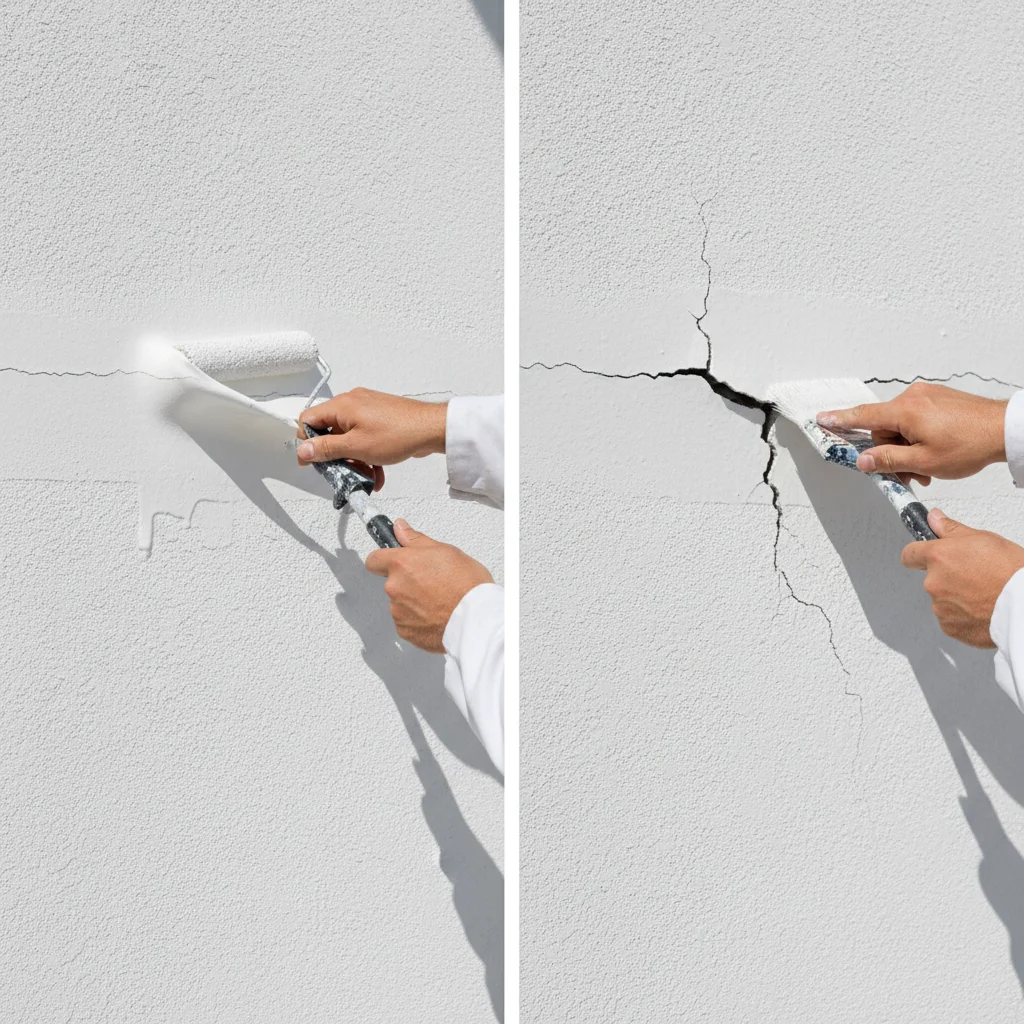
How to choose a stucco painter in San Diego
Most painters in SD County paint stucco. Few specialize in it. Use these five questions to separate them.
1. What’s your prep process specifically for stucco? Right answer mentions pressure wash with mildewcide (especially coastal), crack repair with an elastomeric patch or paintable caulk, and a masonry primer. Wrong answer is “we’ll wash it and start painting.”
2. What primer do you use on stucco? Right answer names a product (Loxon, Behr Masonry & Stucco Primer, Zinsser Peel Stop on chalky surfaces). Wrong answer is “we don’t usually prime stucco” or “the paint has primer built in.” Stucco needs a dedicated masonry primer in almost every case.
3. How do you handle hairline cracks? Right answer is some combination of elastomeric patch compound, paintable urethane caulk worked into the crack, or a high-build elastomeric topcoat. Wrong answer is “the paint covers it.”
4. What does your warranty actually cover? Right answer is something like “5 years labor on peeling, blistering, or premature failure not caused by structural movement or moisture intrusion.” Wrong answer is “lifetime warranty” with no written terms.
5. Can you share references on stucco jobs specifically, not just paint jobs? Stucco painters who do it right will have plenty of references on stucco. If they pivot to “we paint everything,” they treat stucco like wood, and the coating will fail.
For more on choosing an exterior painter generally, see our exterior paint prep on stucco guide and our Sherwin-Williams vs Behr exterior paint comparison.
FAQ
Can I paint my own stucco in San Diego? Yes on a single-story under 1,500 sq ft if you’ve got the time (about 30 to 40 hours of labor), the gear (airless sprayer, ladders, drop cloths, masking, brushes, rollers, and back-roll naps), and you’re willing to skip the warranty. Two-story stucco gets dangerous fast (scaffolding, edges, and gable peaks). Most DIY stucco jobs we see fail at the prep stage. Skipping primer or back-rolling cuts the coating life roughly in half.
What’s the best paint brand for SD stucco? There isn’t one. Sherwin-Williams Loxon XP, Behr Premium Plus Elastomeric, Dunn-Edwards Evershield, and Benjamin Moore Aura Exterior all perform well in SD when applied to properly prepped stucco. We pick based on the specific home’s micro-climate and condition. See our Sherwin-Williams vs Behr stucco comparison for the head-to-head.
Do I need elastomeric paint on stucco? Only if your stucco has active hairline cracking, or it’s an older home where cracks will continue to develop. New or well-maintained stucco with no cracking does fine with a premium 100% acrylic. Elastomeric is thicker, less breathable, and costs 20 to 30 percent more, so don’t pay for it if you don’t need the crack bridging.
When’s the best time of year to paint stucco in San Diego? April through November in most of the County. Avoid the marine-layer mornings (paint before noon doesn’t bond well if surface temperature is below 50 degrees or above 90). Avoid Santa Ana wind events (paint dries too fast and flashes). Late spring and early fall are the sweet spots. Our best time to paint exterior in SD guide has the full month-by-month breakdown.
Can you change stucco color when you repaint? Yes. Going lighter to darker takes the same two coats. Going dark to light sometimes needs a tinted primer plus two finish coats to fully cover. HOA-restricted neighborhoods (most planned communities in Carmel Valley, 4S Ranch, Carmel Mountain, Rancho Bernardo, Otay Ranch, Eastlake) require color approval first. Our HOA paint color rules post covers the process.
How long does a stucco painting job take? Single-story homes: 4 to 7 days from first pressure wash to final cleanup. Two-story: 7 to 14 days. Weather delays can stretch that if a marine layer hangs around longer than forecast or a Santa Ana wind event shows up. A reputable crew won’t paint in conditions that compromise the bond, even if it means an extra day or two.
How much does it cost to paint stucco in San Diego? A single-story 2,000 sqft stucco home runs $7,500 to $14,000 with a quality acrylic system and full prep. Two-story homes run $10,000 to $20,000. Elastomeric systems add 15 to 25 percent because of material cost and additional film thickness. Coastal jobs run higher than inland on the same square footage because of salt and mildew prep. The big swing factor is repair scope on hairline cracks before the paint goes on.
Is it better to paint or restucco a house? Paint if the existing stucco is structurally sound (no delamination, no major water intrusion, no large detached sections). Re-stucco if the substrate is failing, if you have water behind the wall, or if more than 30% of the surface needs patching. Re-stucco runs $7,000 to $14,000 just for the stucco work, then you paint on top of that. Painting alone is $7,500 to $20,000 depending on size. Most San Diego homes built after 1985 just need paint.
Can you spray paint on stucco? Yes, and that’s how most professional stucco jobs are applied. An airless sprayer pushes paint into the surface texture, then a back-roller works the coating into the deep texture pockets that the spray pattern can’t fully reach. Spray-only without back-rolling looks fine for the first 12 months and then chalks fast because the coating sits on top of the texture instead of bonding into it. Always insist on spray-and-back-roll on stucco.
Should you use a primer on stucco before painting? Yes, on any bare or patched stucco, on chalky old paint, and anywhere you’re going from a darker color to a lighter one. Use a masonry conditioner or alkali-resistant primer (Sherwin-Williams Loxon, Behr Concrete and Masonry Primer, Dunn-Edwards EFF-STOP) on new stucco that’s at least 28 days cured. Skip primer only on sound, same-color repaints over an existing intact acrylic finish that’s less than 8 years old.
What is the best paint to use on exterior stucco? A 100% acrylic premium exterior or an elastomeric coating, depending on stucco condition. Sherwin-Williams Loxon XP, Behr Premium Plus Elastomeric, Dunn-Edwards Evershield, and Benjamin Moore Aura Exterior all perform well in San Diego. Choose elastomeric if there’s active hairline cracking. Choose premium acrylic if the stucco is sound. See our elastomeric vs acrylic comparison for the side-by-side.
How long does paint last on stucco? In coastal San Diego (Carlsbad, Encinitas, La Jolla, Coronado), expect 7 to 10 years on a properly prepped repaint with a premium acrylic. Inland and East County (Escondido, Poway, El Cajon, Santee), expect 10 to 15 years. Within 500 feet of the water, expect 6 to 9 years. Elastomeric systems add roughly 2 to 4 years to those ranges. For the full lifespan deep dive, see how often to repaint stucco in San Diego.
Ready for a real stucco painting estimate?
If you’re researching stucco painting in San Diego, get at least two quotes and use the five questions above to vet each one. The cheapest quote is rarely the best value on stucco. Cutting prep is what makes paint fail.
Call (858) 925-5546 for a free Paint Pros San Diego stucco painting estimate, or visit our exterior painting service page to see what’s included.
Sources and references
- Sherwin-Williams Loxon XP technical data sheet: www.sherwin-williams.com
- Sherwin-Williams Loxon Masonry Primer data: www.sherwin-williams.com
- Behr Premium Plus Elastomeric Masonry, Stucco & Brick Paint: www.behr.com
- Benjamin Moore Aura Exterior: www.benjaminmoore.com
- Dunn-Edwards Evershield product page: www.dunnedwards.com
- International Association of Certified Home Inspectors (NACHI) stucco inspection standards: www.nachi.org
- ASTM C926 Standard Specification for Application of Portland Cement-Based Plaster: www.astm.org
- ASTM C1063 Standard Specification for Installation of Lathing and Furring: www.astm.org
- NOAA climate data for San Diego: www.weather.gov/sgx
- climate.gov San Diego precipitation and temperature normals: www.climate.gov
- City of San Diego building permit information: www.sandiego.gov/development-services
- EPA mold and mildew guidance for exterior surfaces: www.epa.gov/mold
- Stucco Manufacturers Association resources: www.stuccomfgassoc.com
- Painting Contractors Association industry standards: www.pcapainted.org