Yes, you can spray your interior walls and ceilings with an airless rig and finish a 1,500 sqft San Diego home in two days. The catch: prep is 80% of the work. Skip it and you’ll ruin your floors, your trim, and probably a window. Most San Diego DIYers get more value spraying ceilings and trim than walls. If the prep starts feeling like more job than you bargained for, call (858) 925-5546 for a free Paint Pros San Diego estimate.
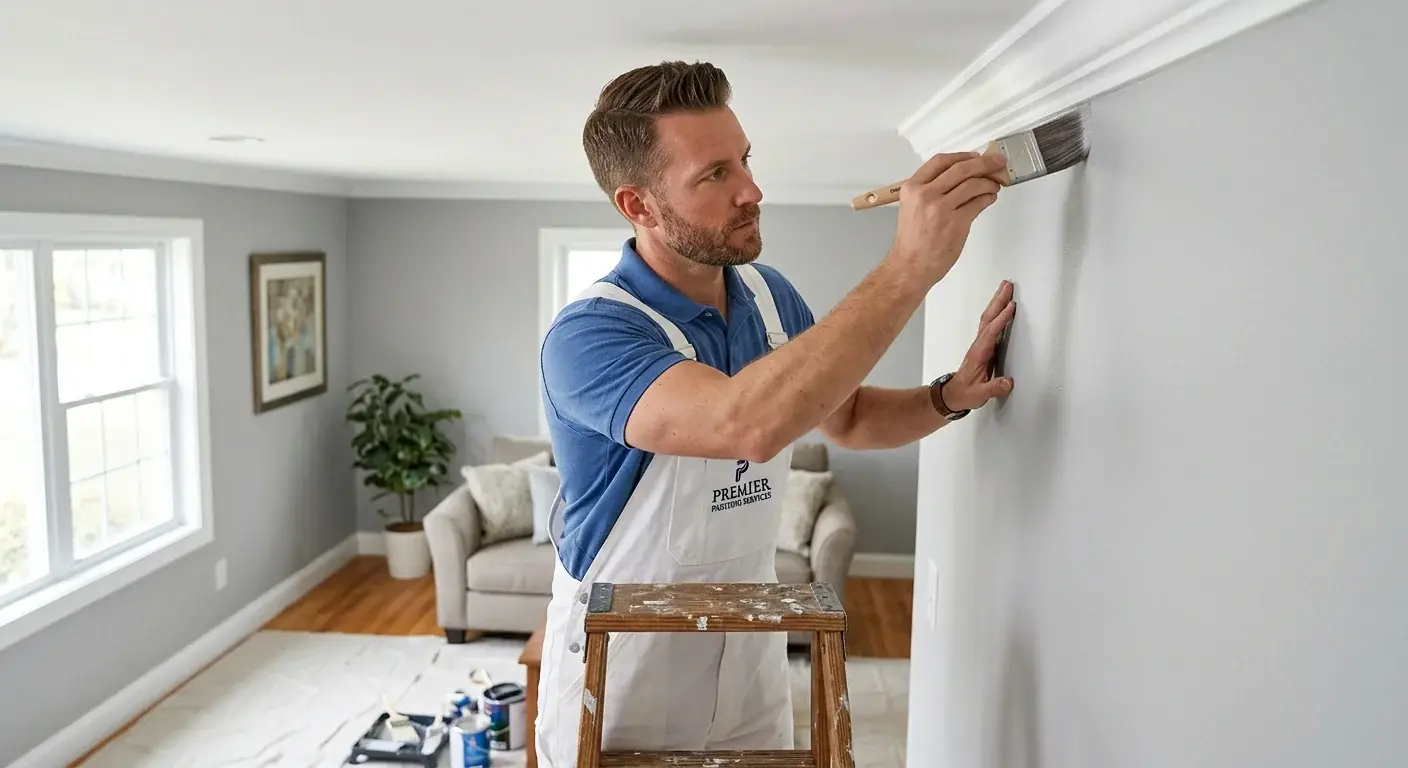
This guide is the sprayer-specific companion to our step-by-step interior painting walkthrough, which leans more on brushes and rollers for furnished rooms. If you’re sizing up the whole project, our complete interior painting guide for San Diego covers planning, colors, and pricing in one place.
When spraying makes sense vs. brush and roller
Spraying isn’t always faster. It’s faster only when the room is empty and the masking is already done. That’s why pros spray new construction and empty whole-house repaints, then switch to brush and roller for one-room touch-ups.
Here’s the honest call for a San Diego homeowner:
- Whole-house repaint, empty rooms: spray. Two days versus a week with rollers.
- One room at a time, furniture in the home: roll. The masking time alone kills the speed advantage.
- Ceilings: spray almost always. Rolling a ceiling is the worst job in painting, and a sprayer drops a flat finish in ten minutes per room.
- Trim, doors, baseboards: spray with careful masking. The finish is glassy and brush-mark free. See our trim and baseboard painting guide for the prep details.
- Cabinet doors: spray off-site (garage or backyard) with proper drying racks. Covered in detail in our professional interior painting process.
If your home is fully furnished and you’re doing one room, a quality roller and a 2.5-inch angled sash brush will finish faster than a sprayer once you count masking. The sprayer wins on volume.
Pick the right airless sprayer
Three tiers cover most DIY needs. All three are airless (pressurized piston pump), which is what you want for latex wall and ceiling paint.
Entry tier: Graco Magnum X5 (~$359). Rated for up to 125 gallons a year. Plenty for a single whole-house repaint. Quarter-inch hose, 0.015-inch max tip. Works for walls, ceilings, fences, decks. The honest downside: the pump is plastic-bodied, and it doesn’t love thick primers. Specs: Graco Magnum X5.
Mid tier: Graco Magnum X7 ($429) or Titan ControlMax 1700 ($429). Rated for 125 to 300 gallons a year. Bigger pump, longer hose, can pull straight from a five-gallon bucket. This is the sweet spot for a homeowner who’ll do two to three projects a year. Specs: Graco Magnum X7 and Titan ControlMax 1700.
Pro tier: Graco ProX17 (~$759) or Titan Impact 410 ($1,200+). Rated for 300+ gallons a year. Metal pump, real swivel hose, runs all day. Overkill for one project. Right answer if you’ve decided to spray annually or you’re prepping a rental.
HVLP alternative: Wagner Flexio 5000 (~$199). Not airless, but worth mentioning. HVLP (high-volume, low-pressure) is slower but produces less overspray. Better for cabinets, doors, and trim than walls. Specs: Wagner Flexio 5000.
For a deeper feature comparison, Family Handyman’s airless sprayer guide and This Old House’s airless sprayer review both run head-to-head tests worth reading.
Tips and nozzle selection (this matters more than the sprayer)
The tip is the small numbered nozzle on the end of the gun. It controls fan width and how much paint flows. Pick wrong and you’ll either flood the wall or get hairline coverage that needs three coats. The number system: first digit doubled equals the fan width in inches, last two digits are the orifice size in thousandths of an inch.
For interior work in a San Diego home:
- Interior walls (flat or eggshell latex): 515 tip. Ten-inch wide fan, 0.015-inch opening. Wide enough to move fast, fine enough not to flood. The workhorse.
- Ceilings (flat ceiling paint): 619 tip. Twelve-inch wide fan, 0.019-inch opening. Heavier paint flow because ceiling paint is thicker and you’re fighting gravity.
- Trim, doors, cabinets (semi-gloss or satin): 211 or 311 tip. Four to six-inch fan, 0.011-inch opening. Tight fan keeps overspray off everything around the trim.
- Heavy primer or texture: 517 or 619. Bigger orifice handles the thicker material.
Buy Graco RAC X FFLP tips or Titan TR1 equivalents. Avoid the no-name tips, they wear in 20 gallons and start spitting.
Replace tips when the fan pattern gets streaky or tail-heavy. A worn tip will ruin a job faster than a worn pump.
Paint thinning and viscosity for airless
Good news: most modern interior latex paint is formulated to spray straight from the can with an airless. No thinning needed. The pump generates enough pressure (2,800 to 3,300 PSI on the units above) to atomize standard wall paint without help.
When you might need to thin:
- Some primers (especially Kilz Original): add up to 10% water if the spec sheet allows. Check the can.
- Heavy-bodied paints like Sherwin-Williams Duration or Benjamin Moore Aura: rare cases need 5% water in low humidity. Check viscosity with a Zahn cup or just test on cardboard first.
- Old paint that’s been sitting: strain through a five-gallon paint strainer mesh before pouring it into the sprayer hopper. Skip this step and a chunk will clog the tip mid-wall.
Always check the paint manufacturer’s spec sheet. Sherwin-Williams’ sprayability guide covers most of their interior line. Over-thinning destroys hide and coverage, so default to spraying neat unless the can says otherwise.
For low-VOC compliance in California (more on this below), stick with paints labeled Green Wise, Green Seal, or Master Painters Institute Extreme Green. They spray fine, no special handling.
Masking and dust containment
This is the part nobody photographs. Masking is 50% of the prep time and 90% of why pro sprayer jobs look clean and DIY sprayer jobs look like a crime scene.
Airless sprayers throw atomized paint that drifts. Even with the best technique, fine paint dust travels six to ten feet from the spray gun. That dust settles on every horizontal surface it can find: floors, baseboards, window sills, light fixtures, your HVAC return.
The minimum masking for spraying interior walls:
- Floors: plastic sheeting (1-mil minimum) covered by builder’s paper or rosin paper. Plastic alone is slick and dangerous on stairs.
- Baseboards and trim (if you’re not spraying them too): 1.5-inch blue painter’s tape plus 12-inch masking paper, run continuous along the bottom of every wall.
- Windows: plastic sheeting taped to the trim, sealed at the top and sides.
- Doors: either remove them or fully mask both sides. Half-masked doors look ridiculous after.
- HVAC vents and returns: plastic sheeting taped over every supply and return. Critical. If you spray with vents open, the system pulls atomized paint through the ductwork and coats the inside of every register in the house. (HVAC must also be off while spraying, see the SD-specific section below.)
- Light fixtures, smoke detectors, thermostats: plastic baggies and tape.
Use a hand masker like the 3M Hand-Masker M3000 to lay masking paper fast. It’s the single tool that separates pros from amateurs on prep time.
If you’re spraying a whole house, expect six to eight hours of masking for a 1,500 sqft home. That’s not slow, that’s normal.
Technique: overlap, pattern, distance, speed
Once the masking is done, the spraying itself is fast and (with practice) easy. Four rules:
- Distance: 12 to 14 inches from the wall. Closer floods and runs. Farther atomizes too much and the finish goes orange-peel.
- Pattern: horizontal first, then vertical second coat. A crosshatch pattern catches missed spots and evens out the build.
- Overlap: 50% on each pass. The fan from the tip is wider in the center than the edges. If you don’t overlap by half, you get vertical stripes.
- Speed: walk, don’t stop. Start the trigger before the wall, release it after. If you stop moving with the trigger pulled, you’ll have a paint run in three seconds. Smooth and continuous, like walking past a window with a flashlight.
Test on a piece of cardboard or scrap drywall first. Adjust pressure (the dial on the pump) until the fan is full but not heavy. Most interior latex sprays well at 1,800 to 2,200 PSI, not max pressure.
Cut in corners and edges with a brush after spraying, or back-roll while the paint is wet for texture matching. Back-rolling a sprayed wall with a 3/8-inch nap roller gives you the smoothest finish that still has a roller texture, which matches what’s already on most San Diego drywall.
SD-specific considerations
This is the part the YouTube tutorials skip because they’re filmed in dry Arizona garages. San Diego has three environmental factors that change how you spray.
Marine layer humidity. From May through August, San Diego sees 70-85% relative humidity on coastal mornings. High humidity slows dry time. A sprayed coat that dries in 30 minutes in Phoenix takes 90+ minutes here. Don’t recoat too soon, or the second coat sits wet on top of partially-dried paint and you get blistering. Wait the full recoat time on the can, and add 50% if it’s June Gloom morning. If you’re spraying near the coast (Carlsbad, Encinitas, Pacific Beach, Coronado), start at 10 a.m. once the marine layer burns off, not at 7 a.m. when the air’s still soaked.
HVAC off and sealed. California homes run AC heavily May through October. Turn it off two hours before you spray and keep it off until the paint is fully dry to touch (usually 2 to 4 hours after spraying). Leaving the AC on while spraying pulls overspray through the ducts and contaminates every vent in the house. Tape over every supply and return register with plastic sheeting and painter’s tape before you start.
California AQMD Rule 1113 (low-VOC paint). All interior architectural paint sold in California must meet South Coast AQMD Rule 1113 limits: 50 grams per liter VOC max for flats, 100 g/L for non-flats. The good news: every major brand (Sherwin-Williams, Benjamin Moore, Dunn-Edwards, Behr, Kelly-Moore) sells AQMD-compliant interior lines. They spray fine. Just don’t pull a five-gallon bucket from a non-California Home Depot and try to use it here, it may exceed limits and trigger a (very rare) inspection issue if you’re working in a permit-required setting. For most homeowners, just buy locally and you’re compliant by default.
Stucco-textured interior walls (rare but they exist on older Spanish-style homes in Mission Hills and La Jolla) need a 619 or 717 tip and a heavier coat to fill the texture. Smooth drywall, which is most San Diego homes built post-1980, sprays clean with a 515.
Cleaning the sprayer after (this is the most underrated step)
Latex paint left in an airless pump for 24 hours will harden into the seals and ruin the pump. Cleaning takes 30 minutes and is non-negotiable.
The process:
- Spray the gun back into the bucket until the hose runs clear-ish.
- Move the suction tube to a bucket of clean water. Pump water through the system until the discharge is fully clear.
- With water still pumping, remove the tip and tip guard, soak both in a separate cup of water.
- Flush the gun by holding it pointed into the bucket, trigger held, until you’ve cycled at least two gallons of clean water through.
- Final flush with Graco Pump Armor (or equivalent) to coat internal parts for storage.
- Wipe down the gun, store the tip in water or pump armor, coil the hose.
Graco Pump Armor is $15 a bottle and saves a $300 pump. Buy it the same day you buy the sprayer.
If you rented the sprayer, the rental yard will charge a cleaning fee on top of the daily rate if you return it dirty. Cheaper to clean it yourself.
When to NOT DIY-spray
Some jobs aren’t worth the risk. Don’t DIY-spray if:
- The interior is heavily textured stucco (full-trowel Spanish texture or knockdown over 1/4-inch). The tip wears fast, coverage is uneven, and back-rolling is mandatory. Hire it out.
- You have popcorn ceilings installed before 1980. Could contain asbestos. Test before disturbing it. See our ceiling texture types guide for the safe path.
- The home was built before 1978 and you don’t know the paint history. Federal EPA RRP rule requires lead-safe certification for sanding, prep, or disturbance of pre-1978 paint. Sprayed paint dust spreads lead farther than any other application method. This is a hire-a-pro situation.
- The home is occupied with pets, kids, or anyone with respiratory sensitivity. Atomized paint hangs in the air for hours. Even low-VOC paint creates fine particulates. Vacate the space for 24 hours minimum.
- You’re working in a small space with no ventilation. Bathrooms and closets, mainly. Brush and roll.
- You can’t tolerate the cleanup time. If 30 minutes of pump flushing sounds like a deal-breaker, you’ll skip it once and ruin the rig. Just hire a pro.
Rent vs. buy decision
Home Depot rents the Graco Magnum X5 for around $80 a day or $200 a week. Sunbelt and United Rentals stock the bigger Magnum X7 and Titan units for $90 to $120 a day.
A new Magnum X5 is $359 at retail. Break-even versus daily rental is four and a half days of project work, or one full whole-house repaint plus a fence stain.
The honest rent-vs-buy call:
- Doing one project ever: rent. $80 to $200 total, sprayer goes back the next day, no storage, no maintenance.
- Doing 2+ projects a year: buy. The Magnum X5 or X7 pays for itself by year two and you’re not chasing rental yard hours.
- Renting only the high-tier units: smart move. If you need a ProX17 or Titan Impact for a big job, rent the pro tier for $120 a day, don’t buy a $759 to $1,200 sprayer for one project.
Add $40 to $60 for a spare tip, paint strainers, pump armor, and a hand masker. These cost the same whether you rent or buy.
FAQ
How much does it cost to rent vs. buy an airless sprayer in San Diego?
Home Depot rents the Graco Magnum X5 for $80/day or $200/week. Buying the same sprayer new is $359. Break-even is roughly 4 to 5 days of rental, which is about one whole-house repaint. Rent if it’s a one-time job, buy if you’ll use it 2+ times a year.
Can you spray over wallpaper?
Technically yes, but it’s a bad idea. Wallpaper seams telegraph through paint, and sprayed paint adds moisture that can lift the paper from the wall. Strip the wallpaper first, repair the drywall, prime, then spray.
How thick is the dust from spraying inside?
A fine paint mist hangs in the air for 1 to 3 hours after spraying. The drift settles up to 10 feet from the gun on every horizontal surface that isn’t masked. After a whole-house spray, expect to vacuum and wipe down every uncovered surface, including light bulbs and the inside of cabinets if their doors were left open.
Can you spray a furnished room?
Not realistically. The masking time on furniture (plastic-wrapping every piece, sealing under and behind it) takes longer than the spraying itself. For a furnished room, roll. For a fully emptied room, spray.
What’s the cure time for sprayed interior paint in San Diego?
Dry to touch in 1 to 2 hours, recoat in 4 hours, full cure in 14 to 21 days. Marine-layer mornings (May to August) add 50% to dry and recoat times. Don’t wash the wall or hang anything heavy for two weeks.
Can I get a free estimate if I decide not to DIY?
Yes. Paint Pros San Diego does free in-home estimates anywhere in San Diego County. Call (858) 925-5546. We’ll quote spray and roll versus full-spray options and tell you honestly which makes sense for your home.
Before you start spraying
If you’ve gotten this far and the prep list still sounds manageable, you’re in a good spot. The skill curve on an airless sprayer is real but short. Most homeowners get the technique down inside the first wall.
A few more reading stops before you start: our paint sheen guide covers which finishes spray cleanest (flat and eggshell easy, semi-gloss tricky on walls). Our 2026 interior color guide helps with the color call. And the interior painting service page is there if you’d rather skip the rental and have us do it.
If the prep starts feeling like more job than you bargained for, call (858) 925-5546 for a free Paint Pros San Diego estimate. We’ll walk the project with you and quote it honestly, including whether DIY makes more sense for your situation. No pressure either way.