Looking for a painting contractor in Alpine, CA? We handle exterior repaints, interior work, cabinet refinishing, stucco prep, and fire-resistant exterior coatings for mountain-foothills homes across Alpine, Harbison Canyon, Crest, and Descanso. A typical 2,500 to 3,500 sqft Alpine home runs $8,500 to $17,500 for a full exterior, with custom estate homes on multi-acre parcels running higher. Call (858) 925-5546 for a free estimate.
Alpine neighborhoods and what each one needs
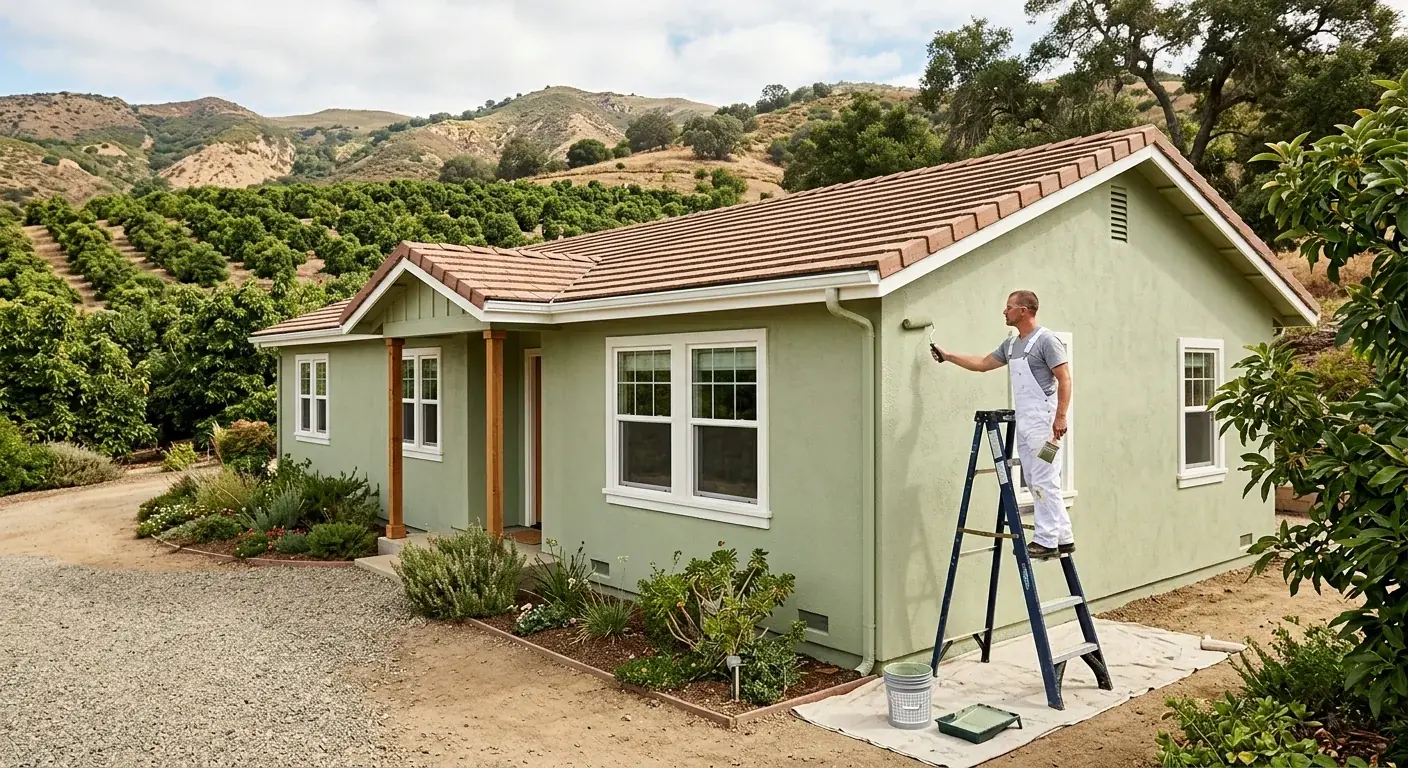
Alpine is unincorporated East San Diego County along the I-8 corridor, sitting between 1,700 and 2,000 feet of elevation. The housing stock is a mix that changes the paint scope from one street to the next.
Alpine Heights and Rancho Palo Verde. Newer master-planned subdivisions built largely in the 1990s and 2000s. Two-story stucco homes, 2,500 to 4,500 sqft, smaller lots than the rural acreage parcels. Standard exterior repaint scope here is wash, hairline crack repair, premium acrylic, and trim refinishing. Quicker turnarounds because the houses are clustered and crews aren’t driving between addresses.
Downtown Alpine and the Tavern Road corridor. Older single-story ranch homes from the 1970s and 1980s on quarter-acre to one-acre lots. Mixed substrates: original stucco, T1-11 plywood siding, cedar accents that have weathered through several owners. Prep takes longer because we’re often dealing with chalking, peeling on south-facing walls, and dry-rotted trim that needs replacement before paint.
Anderson Hills and the Anderson Road equestrian zone. Rural large-lot homes, 1 to 5+ acres common, often with barns, tack rooms, and outbuildings that homeowners want painted on the same trip. Travel between buildings on the property is real time, and we price accordingly.
Sweetwater Springs road corridor and rural-edge properties. The most isolated work in our service area, with single-track driveways and long approaches. We’ll do a site visit before the estimate to make sure our spray rigs and lift equipment can actually get to where the work is.
Fire-rebuild homes from the 2003-2010 era. Properties that were rebuilt after the 2003 Cedar Fire are now hitting 15 to 20 years on their original paint cycle. Most are due for a full repaint and a re-evaluation of exterior coatings, including the Class A roof and eave assemblies that were specified during the rebuild.
Alpine’s mountain-foothills climate (and what it does to paint)
Alpine sits 10 to 15 degrees cooler than the El Cajon valley floor below. That’s the basic climate story, but the specifics matter for paint work.
Higher elevation UV. At 1,800 feet, UV intensity is meaningfully higher than at sea level. NOAA climate data shows summer surface temps on south-facing stucco that can push past 140 degrees on dark colors. Mid-tier exterior paint fades and chalks fast here. Premium 100% acrylic with high-grade UV resin is the baseline spec, not an upgrade.
Cooler nights and longer cure times. Even in summer, nighttime lows in Alpine drop into the 50s and 60s. That extends cure times for elastomeric and modified-acrylic coatings beyond what crews are used to in the valley. Rushed recoats trap moisture and cause adhesion failures six months later. We slow the schedule down and use cure-time data sheets, not gut feel.
Occasional winter freeze. Alpine gets frost nights and the rare snow event. Cuyamaca area NOAA records show nearby east-county stations hitting the high 20s several nights per winter. We don’t paint exteriors when overnight lows are forecast below 50 for the next 72 hours.
Dry summer with WUI fire-risk season. From late May through October, Alpine sits in active fire-risk territory. Red Flag warnings and Public Safety Power Shutoffs (PSPS) are common. We watch the CAL FIRE incident map and the National Weather Service Red Flag forecasts during scheduling. Crews don’t run pressure washers or sprayers on Red Flag days.
Hard well-water and pine-pollen prep complications. A lot of Alpine homes are on well systems with high mineral content. Hard water leaves residue on stucco after pressure washing, which interferes with adhesion. We carry a TSP rinse on rural Alpine jobs as standard. Pine pollen and oak debris add a second prep complication in spring, when pollen literally coats the substrate within hours of washing.
The combined effect: Alpine’s paint cycle is shorter than coastal La Jolla but in the same range as inland Rainbow, generally 8 to 10 years on premium acrylic with proper prep. See how long exterior paint lasts in San Diego for the longer breakdown.
Fire-safe painting in Alpine
Alpine sits in the Wildland-Urban Interface (WUI) zone, where most of the community falls within moderate to very-high fire-hazard severity zones mapped by CAL FIRE. Paint isn’t a fire-rated coating in the way a Class A roof is, but exterior coatings and prep choices do interact with California Building Code Chapter 7A requirements for WUI construction.
Fire-rebuild homes hitting their paint cycle. Homes rebuilt after the 2003 Cedar Fire (which destroyed roughly 280 homes in Alpine alone, per San Diego Union-Tribune coverage) used 7A-compliant assemblies: ignition-resistant siding, Class A roofing, ember-resistant vents, boxed eaves. Those assemblies are now 15 to 20 years into service and most are due for full exterior repaint plus inspection of caulking, vent screens, and exterior wood elements.
Fire-resistant exterior paint options. Several manufacturers now offer intumescent or fire-retardant exterior coatings rated for ignition resistance. Sherwin-Williams and Dunn-Edwards both carry product lines suitable for WUI applications, and Behr has consumer-grade exterior products with good UV durability for the climate. We spec product per substrate and per homeowner’s defensible-space planning, not by default.
Class A roof and eave coatings. On homes with painted metal roofing, board-and-batten gable ends, or exposed rafter tails, the coating itself is part of the fire-resistance picture. We coordinate roof-and-eave coating work with the homeowner’s defensible-space plan and any insurance carrier requirements. Some carriers now require photos and product data sheets for WUI properties.
Defensible-space coordination. Painting work often overlaps with the homeowner’s Zone 0 (0 to 5 feet from the structure) and Zone 1 (5 to 30 feet) defensible-space work. We schedule pressure washing and prep around tree work, brush clearing, and any irrigation changes so the same wall doesn’t get blasted twice. The CAL FIRE defensible space guide is the standard reference.
Cost ranges by Alpine home size
Alpine homes skew larger than the county average because of the rural large-lot pattern and the custom estate stock. Travel time also factors in: most Alpine addresses are 35 to 50 minutes from our valley shop, which adds setup and breakdown cost to each project day. Rural well-water access adds prep complexity. The ranges below assume premium acrylic paint, full prep, and two finish coats.
| Home size | Exterior repaint | Interior repaint | Cabinet refinish (kitchen) |
|---|---|---|---|
| 2,000 sqft single-story | $7,000 to $11,500 | $4,500 to $7,500 | $3,500 to $6,500 |
| 2,500 sqft single-story | $8,500 to $14,000 | $5,500 to $9,000 | $4,000 to $7,500 |
| 3,500 sqft two-story | $12,000 to $19,000 | $7,500 to $12,500 | $5,000 to $9,500 |
| 4,500+ sqft custom estate | $17,500 to $32,000+ | $11,000 to $18,000+ | $6,500 to $12,500+ |
Custom estates with cedar siding, beam-and-rafter exposed work, outbuildings, and gated property access run at the top of these ranges or above. Fire-resistant coating product upgrades add roughly 12 to 25 percent to material cost depending on product spec. See exterior painting cost in San Diego for the methodology behind these numbers.
Common Alpine paint issues
UV burn on south and west elevations. The elevation UV exposure shows up first on south and west walls within 3 to 5 years on mid-tier paint. Premium acrylic with high-grade UV resin pushes that to 7 to 9 years. The fix is product selection, not heavier application.
Hairline crack patterns from heat cycling. Stucco substrates expand and contract more aggressively at elevation because the daily temperature swing is wider. Summer days at 95 degrees dropping to 55 overnight produces 40-degree swings that crack stucco at corner beads, window returns, and gable transitions. We spec elastomeric on cracked stucco and use flexible caulk at every transition. The common stucco problems in San Diego post covers the diagnostic walk.
Pine sap, pine pollen, oak debris. Three different prep complications, all common on Alpine lots. Pine sap on trim and eaves doesn’t come off with a pressure wash alone; we use a citrus solvent and hand-clean before priming. Pine pollen in spring lands on substrate within hours of washing, so we time prep tight to paint day. Oak leaf debris and tannins stain stucco below mature oaks, and we use a stain-blocking primer in those spots.
Wood-burning fireplace smoke staining (interior). Many Alpine homes use wood-burning fireplaces through the cool months. Smoke staining on ceilings and walls above the firebox is routine pre-paint prep. We use Zinsser BIN shellac primer to block tannin and smoke stains before finish coats, otherwise the bleed-through shows up in 30 to 60 days.
Well-water hardness affecting wash prep. As mentioned above, mineral residue from hard well water interferes with adhesion. We carry TSP rinse and water from our valley shop when a job’s well water tests very hard.
Services for Alpine homes
Exterior painting. Full house exteriors, stucco, board-and-batten, T1-11, cedar siding, trim, fascia, eaves, gable vents. Standard scope is wash, repair, prime, two finish coats.
Interior painting. Whole-house refreshes, single rooms, accent walls, ceilings, trim, doors. Most Alpine interior calls are full-house repaints during long-term ownership updates.
Cabinet refinishing. 1980s through 2000s custom kitchens are the most common cabinet job in Alpine. Spray-finished cabinet refinishing with a converted-varnish or 2K polyurethane lasts 8 to 12 years and runs roughly 35 to 50 percent of full cabinet replacement cost.
Stucco painting and prep. Hairline crack repair, partial re-skim on bad sections, elastomeric application on substrates that need flexibility. See elastomeric vs acrylic on stucco.
Fire-resistant exterior coatings. Spec’d for WUI properties, fire-rebuild homes, and properties working through insurance carrier requirements.
Fence and gate painting. Wood, metal, and composite. Common scope on horse and equestrian properties along Anderson Road and the rural corridors.
Garage floor coating. Polyaspartic and epoxy floor coatings. Common upgrade for Alpine homes with detached garages and shop buildings.
Choosing a painter in Alpine: 5 questions to ask
1. What’s your travel charge for rural Alpine addresses? Some painters absorb travel into the bid, some itemize it, some quietly inflate the labor estimate. Ask for a clear answer. We bid travel into the project price and tell you what that number is if you ask.
2. Do you have fire-safe coating experience? Most coastal and valley painters don’t work on WUI properties regularly and aren’t familiar with 7A-compliant assemblies or fire-resistant product specs. Ask for examples of fire-rebuild or defensible-space coordinated jobs.
3. What’s your pressure-wash setup for well-water properties? A good answer mentions TSP rinse, mineral-residue neutralization, or hauled water for hard-water properties. If the painter doesn’t know what you’re asking about, that’s the answer.
4. Are you generator-equipped for PSPS days? Alpine is on the PSPS map. SDG&E shuts power for high-wind fire-risk windows several times per fire season. A crew without generator backup loses days when this happens. We bring generators on every Alpine job during fire season.
5. How do you schedule around Red Flag warnings? A real answer mentions monitoring the National Weather Service forecast and not running pressure washers, sprayers, or sanders on Red Flag days. Anyone who hasn’t thought about it isn’t ready for Alpine work.
FAQ
How much does it cost to travel from the valley to paint a home in Alpine? Travel adds roughly $200 to $600 to project cost depending on crew size and project length. Most of that is setup and breakdown time, not fuel. On longer projects (8+ working days), travel is a smaller percentage of the total bid.
What fire-safe paint options do you offer for Alpine properties? We spec product per substrate. Sherwin-Williams Emerald and Dunn-Edwards Evershield are our baseline premium acrylics. For homes with insurance carrier requirements or active defensible-space planning, we’ll bring in fire-resistant or intumescent coatings rated for WUI applications. The right product depends on the substrate, the assembly, and the homeowner’s risk planning.
Do you serve Harbison Canyon, Crest, and Descanso? Yes. Harbison Canyon and Crest are 10 to 15 minutes from central Alpine, and Descanso is 15 minutes further east on I-8. Same travel pricing structure. See our Harbison Canyon stucco painting post for an example of the work in adjacent communities, and our Rainbow painting contractor post for a parallel breakdown of rural North County work.
Are your crews generator-equipped during PSPS shutoffs? Yes. Our Alpine and east-county crews carry generators during fire season (roughly May through November). PSPS events shouldn’t stop a project that’s already scheduled.
When’s the best time to paint a home in Alpine’s mountain climate? April through early November is the working window. We avoid the hottest July and August afternoons (we’ll work mornings and break by mid-day on heat waves), and we avoid Red Flag days. Late September and October are the best stretch of the year for exterior work in Alpine: warm enough for proper cure, no rain, lower fire weather. See best time to paint exterior in San Diego for the regional version.
Do you provide free estimates for Alpine properties? Yes. We come out, walk the property, and bid in writing. Larger custom estates and rural acreage properties get a longer walk because the scope is more variable. No charge for the estimate.
Local resources
For homeowners doing their own research on contractors and code:
- San Diego County demographics and unincorporated area data
- CAL FIRE WUI fire-safe building code reference
- NOAA climate data for east San Diego County including the Cuyamaca station near Alpine
- climate.gov mountain east San Diego regional summaries
- Better Business Bureau San Diego for complaint history on local contractors
For neighborhood and city-page information specific to your address, see our Alpine painting service page and the broader painters in San Diego County guide.
Call us for a free Alpine painting estimate
We’re a local San Diego County crew, we work Alpine and the east-county foothills routinely, and we handle the full scope on rural properties: exterior, interior, cabinet, stucco, fire-resistant coatings, fence-and-gate, and garage floor coating. Call (858) 925-5546 for a free Alpine painting estimate.