Most Harbison Canyon homes are 1970s to early-2000s ranch stucco, and a big share of the housing stock got rebuilt or re-stuccoed after the 2003 Cedar Fire and 2007 Witch Creek Fire. Those rebuilds are now 18 to 22 years old, which is end of paint life for inland east county. A full stucco repaint on a 1,500 to 2,500 sqft Harbison Canyon home runs about $4,500 to $9,500 with proper prep, crack repair, and a UV-rated acrylic like Sherwin-Williams Loxon XP or Dunn-Edwards Evershield. Call (858) 925-5546 for a free estimate.
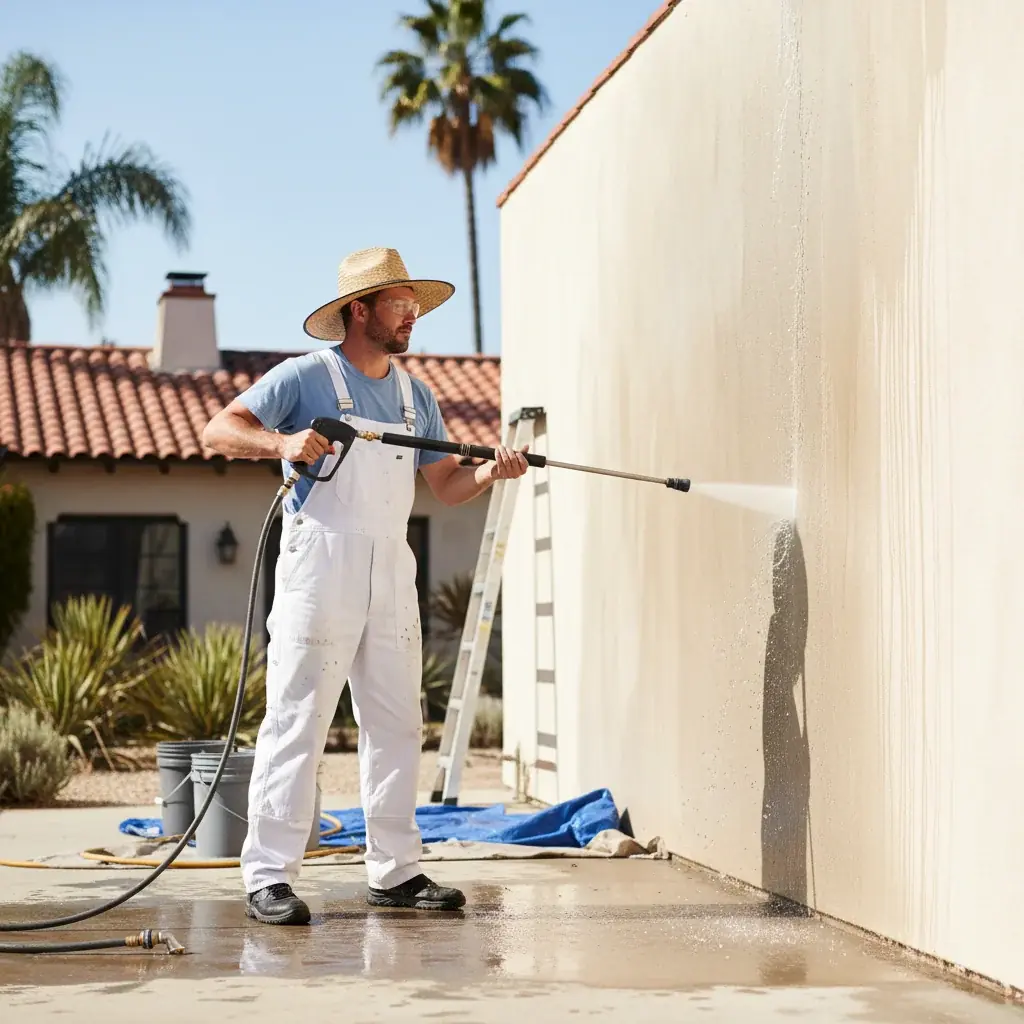
Why Harbison Canyon stucco needs attention now
Harbison Canyon is an unincorporated community of around 3,800 people east of El Cajon, between Crest, Dehesa, and Alpine. The 2003 Cedar Fire destroyed hundreds of structures in the canyon, and the 2007 Witch Creek Fire damaged or threatened many of the rebuilds. As a result, the housing mix today is heavy on early-to-mid 2000s reconstruction (per CAL FIRE post-fire damage reporting), built to the post-fire stucco-with-foam systems that became standard for fire-hardened exteriors.
That generation of stucco is now 18 to 22 years old. Paint film on inland east-county stucco rarely lasts beyond 10 to 15 years before fading, chalking, and hairline crack telegraphing show up. If your Harbison Canyon home was rebuilt or re-stuccoed between 2003 and 2008 and hasn’t been repainted since, you’re almost certainly past due. The visible signs are color shift on south and west walls, dry chalk that rubs off on your hand, and thin spider cracks at window corners and along control joints. Our broader stucco painting San Diego guide walks through the same prep flow we use canyon-wide.
Harbison Canyon climate considerations
Harbison Canyon sits at roughly 1,000 feet of elevation in the inland east county. That puts it in a different paint-spec category than coastal SD. According to NOAA climate data for inland San Diego County, summer afternoon highs regularly hit 95°F to 105°F, and south or west-facing stucco walls can reach surface temperatures of 110°F to 130°F in July and August. That heat load is what cooks coatings off the wall ahead of schedule.
Three climate factors drive paint selection in HC:
Santa Ana winds. Fall and winter Santa Ana events push relative humidity below 15% with sustained winds of 25 to 50 mph. That accelerates paint dehydration during cure and after. A paint that flashes or skins too fast leaves a brittle film. We schedule sprays around the Santa Ana forecast, not on it.
UV load. Low humidity means clear sky and high UV index. UV is what fades color and degrades the binder. You want a 100% acrylic resin rated for high-UV exteriors. Sherwin-Williams Loxon XP and Dunn-Edwards Evershield are both spec’d for this load.
Thermal cycling. HC days can swing 40°F from afternoon to dawn. That repeated expand-and-contract is what opens hairline cracks at corners and joints. The fix isn’t more paint, it’s elastomeric patching at the cracks before the top coat (see our common stucco problems San Diego breakdown).
Cost ranges for Harbison Canyon ranch homes
These ranges assume single-story stucco with normal access, average crack repair (15 to 30 hairlines, a few control-joint failures), pressure wash, primer where needed, and two finish coats. They don’t include heavy stucco repair, lead testing on pre-1978 trim, or HOA color approval.
| Home size | Typical range | What changes the price |
|---|---|---|
| 1,500 sqft single-story | $4,500 to $6,500 | Stucco condition, eave and fascia footage, garage door count |
| 2,000 sqft single-story | $5,500 to $7,800 | Crack volume, foam-substrate vs. 3-coat, primer needs |
| 2,500 sqft single-story or split-level | $7,000 to $9,500 | Two-story sections, retaining walls, detached structures |
If your home has a separate garage, casita, or workshop (common in HC because of lot size), each detached structure adds roughly $800 to $2,500 depending on size and condition. Our exterior painting cost San Diego guide has wider county ranges if you want a coastal-vs-inland comparison.
Repair before repaint: HC-specific issues
Harbison Canyon stucco comes in two main flavors, and the repair plan is different for each.
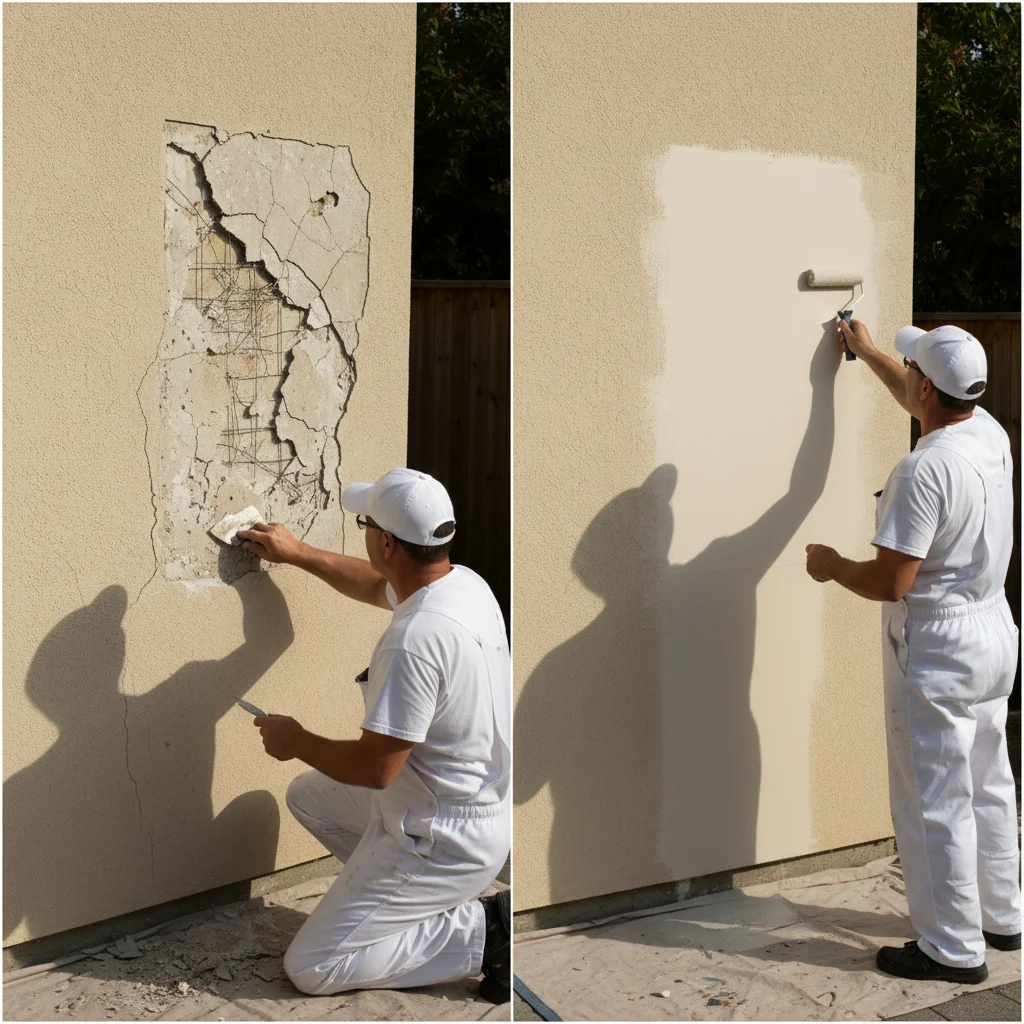
Traditional 3-coat stucco (pre-2000 homes). Scratch coat, brown coat, and a cement finish over wire lath. Hairline cracks here are usually shrinkage and thermal, and they patch well with a flexible acrylic crack filler or, for anything over 1/16 inch, a Type S mortar repair followed by an elastomeric bridge coat just at the crack. ASTM C926 is the governing application standard.
Stucco-with-foam systems (post-Cedar Fire rebuilds). Most homes rebuilt in 2003 to 2008 use a thinner stucco layer over rigid foam insulation. These show different crack patterns, often along the foam board seams in a slight grid. Don’t aggressively scrape or chip these. The foam dents and the patch telegraphs. A skim coat with a fiber-reinforced acrylic patch and a full primer pass works better.
You can tell which system you have by tapping the wall. Hollow-sounding panels with a slight give = foam substrate. Solid, dead sound = traditional 3-coat. Photograph and measure cracks before you call for estimates. Painters who actually look at the wall, not just the square footage, give more accurate quotes.
Best paint for Harbison Canyon conditions
Here’s where a lot of inland homeowners get bad advice. The default recommendation for cracked stucco is full elastomeric. For HC, that’s wrong in most cases.
Elastomeric coatings are thick (10 to 20 mils dry), waterproof, and flexible. They bridge cracks well. But they also dramatically reduce vapor permeability, and inland stucco needs to breathe. Trap moisture behind a full elastomeric film in a 100°F+ summer wall and you get blistering, bubbling, and bond failure. Our elastomeric vs. acrylic paint comparison goes deeper on the tradeoffs.
The right HC spec is usually:
- Field coat: 100% acrylic exterior, UV-rated, breathable. Sherwin-Williams Loxon XP or Dunn-Edwards Evershield. Two coats over a clean, primed, repaired wall.
- Problem zones only: elastomeric patch material or an elastomeric brush-applied bridge coat at active cracks and control joints. Then top-coat over with the acrylic so the whole wall reads as one finish.
- Primer: Loxon Conditioner or equivalent masonry primer on bare or heavily chalked sections. Skip primer over sound previously-painted stucco that washes clean and isn’t chalking.
That setup gives you the crack performance of elastomeric where you need it without sealing the wall shut where you don’t.
Choosing a painter for Harbison Canyon
Five questions worth asking any contractor before you sign:
1. Have you painted in HC, Crest, Dehesa, or Alpine in the last 24 months? Inland east-county work is different from La Jolla or Encinitas work. Ask for an address you can drive by.
2. How do you handle Santa Ana season scheduling? Painting during a Santa Ana event is asking for film defects. A painter who answers “we just push through” is a no. The right answer is they monitor the NWS San Diego forecast and reschedule sprays when winds exceed 20 mph or RH drops below 25%.
3. Do you bring generator-powered sprayers? HC is on SDG&E’s Public Safety Power Shutoff map, and outages happen during high-wind events. A crew with a portable generator and battery sprayers keeps a job moving when the meter goes dark.
4. What’s your fire-clearance access plan? Many HC lots have brushed-back fire defensible space and gated rural driveways. Your painter needs to know how to stage trucks, ladders, and material without parking on dry vegetation.
5. Acrylic-only, full elastomeric, or hybrid? Default-to-elastomeric is a yellow flag in HC. The right answer is the hybrid spec above (or a clear explanation of why your specific wall needs something different).
If you want a starting point, our stucco painting service covers HC and the surrounding east-county communities. Call (858) 925-5546.
How often should you repaint stucco in HC?
In inland east county, plan on a full repaint every 10 to 12 years on average. South and west walls fade faster than north and east. A high-quality acrylic system, well-prepped, can stretch to 13 to 15 years. Skip prep or use a builder-grade flat and you’re back at 5 to 7 years. Our how often to repaint stucco post has the longer breakdown.
A pattern we see across HC: homeowners hold off because the wall “still looks okay,” then a Santa Ana event blows fine debris into chalking paint and the next rain leaves streaks that won’t wash off. That’s not a stain, that’s failed binder. Once the binder gives up, the paint isn’t protecting the stucco from water intrusion anymore, and the underlying repairs get more expensive. The right time to repaint is when you can rub a chalky residue off the wall with a damp rag, not when the color is visibly gone.
Color choice matters more here than coastal SD too. Dark colors absorb more heat and run hotter, which accelerates film breakdown on south and west walls. Most HC homes that hold up best long-term are mid-tone earth colors (warm tans, soft sages, muted terracottas) rather than charcoals or deep navies. If you’re set on a darker scheme, plan to repaint south and west walls 2 to 3 years sooner than the rest of the house, or spec the darker shade in a heat-reflective formula. For a paint chemistry primer, Sherwin-Williams’ guide to exterior color and heat absorption covers the same ground for any wall material.
FAQs about Harbison Canyon stucco painting
How long does exterior paint last in HC heat? A properly prepped acrylic system (Loxon XP or Evershield) lasts 10 to 13 years in HC’s inland heat and UV. Cheap flat goes 5 to 7. Elastomeric used incorrectly can fail in 3 to 5 from trapped moisture.
Can you paint during Santa Ana season? Not during an active event. We work the shoulder days. Spec sheets from Sherwin-Williams call for 25% to 90% RH and surface temps below 90°F at application. Santa Ana days violate both.
Do you serve Crest, Dehesa, and Alpine? Yes. We treat the four communities (Harbison Canyon, Crest, Dehesa, Alpine) as one inland east-county service zone. Same crew, same paint spec.
Is there a warranty on the work? Our standard workmanship coverage runs two years from completion, with the paint manufacturer’s product warranty stacked on top (Sherwin-Williams and Dunn-Edwards both publish multi-year coverage on their premium exterior lines). We document the prep and the products used so the manufacturer warranty actually applies.
When’s the best month to paint in HC? April through June, and October through early November. You want days with afternoon temps in the 70s to mid-80s, RH above 30%, and no Santa Ana in the 5-day forecast. We avoid July and August on south and west walls because of surface-temperature limits.
What if my home was rebuilt after the Cedar Fire? Those rebuilds (2003 to 2008) are the heart of the HC repaint backlog right now. They almost always need crack repair at foam-board seams, a primer pass, and two acrylic finish coats. Budget the higher end of the cost range for the size.
Ready for a Harbison Canyon estimate?
We paint Harbison Canyon, Crest, Dehesa, Alpine, and the rest of inland east county. Free, on-site estimates with a written scope, paint spec, and price (not a square-foot calculator from a desk).
Call (858) 925-5546 for a free Harbison Canyon stucco painting estimate. Per San Diego County demographics, HC is small enough that we know most of the neighborhoods by name. Tell us the cross street, we’ll know the lot.